
From Teaching in a Small Classroom to Building a Global Math Education Brand: The Story of Manan Khurma and Cuemath
Discover how Manan Khurma transformed his passion for mathematics and teaching into Cuemath, a global math education brand. Explore his entrepreneurial journey, innovative approach to math learning, and mission to help children develop strong problem-solving skills through personalized education.
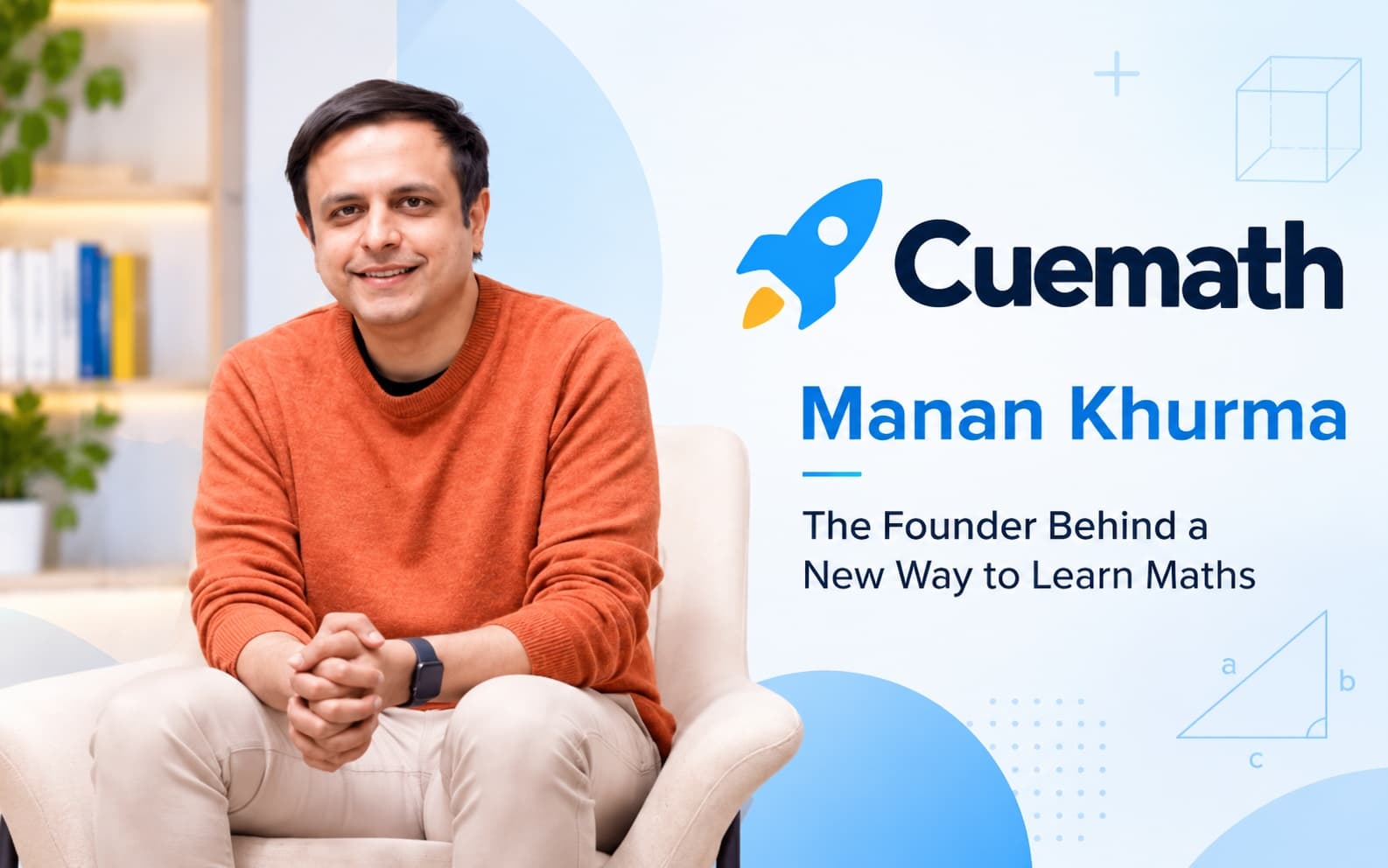
In this story18 sections
- 1.The Story
- 2.1. A Young Entrepreneur With a Passion for Mathematics
- 3.2. His First Business: Locus Education
- 4.3. The Insight That Led to Cuemath
- 5.4. Starting Small and Building the Learning Model
- 6.5. The Challenges of the Early Years
- 7.6. Turning an Education Programme Into a Scalable Business
- 8.7. How the Pandemic Accelerated Online Learning
- 9.8. Attracting Investors and Expanding the Business
- 10.9. What Made Cuemath Different?
- 11.10. Lessons for Aspiring Entrepreneurs
- Start With a Problem You Understand
- Use Your First Business as a Learning Experience
- Build the Product Before Chasing Scale
- Create a Repeatable Business Model
- Use Technology to Remove Real Limitations
- Be Prepared to Adapt
- 12.The Bigger Picture
Category: Education & Entrepreneurship
Founder: Manan Khurma
Reading Time: 7 min
The Story
Some businesses begin with a revolutionary invention. Others begin when someone notices a problem that everyone else has learned to accept.
For Manan Khurma, the founder of Cuemath, that problem was mathematics education.
While teaching students preparing for competitive examinations, Khurma noticed that many struggled with advanced mathematics not because they lacked ability, but because they had never developed a strong understanding of the fundamentals. By the time they reached higher grades, correcting those gaps had become increasingly difficult.
Instead of focusing exclusively on helping older students prepare for examinations, he began thinking about a different opportunity: what if children could develop strong mathematical foundations from the very beginning?
That question eventually led to Cuemath, an education business founded in 2013 that set out to make mathematics more intuitive, engaging and accessible to young learners.
1. A Young Entrepreneur With a Passion for Mathematics
Manan Khurma graduated from the Indian Institute of Technology Delhi with a degree in engineering. Mathematics had been an important part of his life since childhood, and he began teaching students while still studying.
Initially, teaching was a way to share his knowledge and earn some extra money. Over time, however, the informal tutoring developed into something more substantial.
Khurma began working with students preparing for the highly competitive IIT-JEE entrance examinations. He saw first-hand how students approached mathematical problems, where they struggled and why some found it difficult to move beyond memorising formulas.
These experiences gave him more than teaching experience. They helped him understand the relationship between early learning, conceptual understanding and long-term academic performance.
He began to recognise that a student's difficulties in advanced mathematics could often be traced back to concepts they had not fully understood years earlier.
For an entrepreneur interested in education, this was an important insight: the problem was not simply how to prepare students for examinations, but how to help them learn mathematics properly in the first place.
2. His First Business: Locus Education
Before Cuemath, Khurma had already experienced the challenges of building an education company.
In 2007, he co-founded Locus Education with Niraj Singh. The business focused on mathematics and test preparation for students aspiring to enter prestigious engineering colleges.
The company grew beyond an informal tutoring operation and trained more than 10,000 students across cities including Delhi, Gurugram, Lucknow and Jaipur.
Running Locus Education taught Khurma how to develop learning materials, attract students, work with teachers and operate an education business.
It also exposed him to a difficult challenge: maintaining teaching quality while expanding.
A teacher can closely understand the needs of a limited number of students. But when an education business grows, ensuring that every student receives a consistent and effective learning experience becomes much more complicated.
Around 2010–2011, the founders sold the business to another education player.
The experience was an important stage in Khurma's entrepreneurial journey. He had built a business, gained practical operating experience and learned lessons that would influence his next venture.
More importantly, his time teaching thousands of students strengthened his belief that meaningful improvements in mathematics education needed to begin much earlier.
3. The Insight That Led to Cuemath
After leaving Locus Education, Khurma continued exploring mathematics education, working on educational materials and learning systems.
His central observation remained the same: by the time many students reached Classes 9–12, their understanding of mathematics had already been shaped by years of learning habits.
If they had developed misconceptions about basic concepts, helping them overcome those problems could be difficult.
He believed the solution was to introduce children to mathematics differently from the beginning.
Rather than teaching mathematics as a collection of formulas to memorise, children should learn to understand numbers, recognise patterns, explore relationships and develop logical reasoning.
This approach could help children build confidence and see mathematics as a skill they could develop rather than a subject they were either naturally good or bad at.
In December 2013, Khurma founded Cuemath to turn that idea into a structured educational programme.
4. Starting Small and Building the Learning Model
Cuemath did not begin as a massive online education platform.
Its early model centred on a carefully designed curriculum delivered through small, home-based learning centres operated by partner teachers.
The company developed teaching materials, including workbooks, puzzles and interactive learning activities, to help children understand mathematical concepts in different ways.
Instead of relying solely on conventional classroom instruction, the programme encouraged students to engage with problems and understand the reasoning behind their answers.
Cuemath recruited qualified teachers, including educators who wanted to teach from home and build their own small teaching operations.
This created an arrangement in which the company supplied the curriculum and learning framework while teachers worked directly with children in their communities.
The model offered several advantages. It allowed Cuemath to test its teaching approach in real learning environments, build relationships with parents and expand without having to establish a company-owned centre in every neighbourhood.
It also created opportunities for teachers to participate in an organised education business without setting up an independent coaching institute from scratch.
5. The Challenges of the Early Years
Cuemath's early journey was not without difficulty.
The company needed to convince parents that its approach to mathematics was valuable, particularly when many families were accustomed to measuring educational progress through examination scores and school grades.
It also needed to recruit teachers, refine its curriculum and demonstrate that the learning model could work consistently across different students and locations.
Developing educational content that was both engaging and academically useful required experimentation. A teaching approach that worked for one child did not necessarily work equally well for another.
The company also faced funding challenges. According to YourStory's reporting, Khurma struggled to secure outside investment during the early stages and considered shutting down parts of the business.
However, by 2015, Cuemath had established a network of approximately 100 partner teachers in the Delhi-NCR region. Positive feedback from families helped demonstrate that there was demand for its approach.
That progress helped the company secure seed funding of approximately ₹1 crore from Unitus Seed Fund, giving it additional resources to expand its teacher network and develop its business.
The experience illustrated an important lesson for young entrepreneurs: a promising idea needs evidence that customers value the product before it can become a scalable business.
6. Turning an Education Programme Into a Scalable Business
As Cuemath expanded, the company needed to solve a new problem.
Its home-based learning model depended on teachers operating in particular locations. Families living in areas without partner teachers could not easily access the programme.
To reach more students, the company needed a delivery model that was less dependent on geography.
Technology offered an opportunity.
Cuemath began developing online learning capabilities around 2017–2018, exploring how live teaching and digital tools could preserve the personal attention that had been central to its original model.
The objective was not simply to move educational content onto a screen. The company wanted to retain interaction between teachers and students while making lessons accessible to families beyond its existing network.
This transition required product development, changes to teaching practices and a new way of connecting educators with learners.
The business was evolving from a network of local learning centres into a technology-enabled education platform.
7. How the Pandemic Accelerated Online Learning
The COVID-19 pandemic disrupted traditional education in 2020, forcing schools, tutors and education companies to rethink how they delivered lessons.
For Cuemath, the shift to online learning became an important moment.
The company had already been developing its online model, and it was able to transition its teacher network to online classes during the disruption.
Digital delivery removed some of the geographical limitations of the earlier home-based model. Teachers could work with students who were not located in the same neighbourhood, and families could access lessons without travelling to a physical centre.
The move also created opportunities to serve international markets.
However, online education brought its own challenges. Companies needed to maintain student engagement, ensure effective teaching and build trust with parents who were evaluating a digital learning experience.
Cuemath's development demonstrated how technology could extend an existing educational model when it was designed around a genuine learning need.
8. Attracting Investors and Expanding the Business
As Cuemath developed its product and expanded its reach, it attracted investment from established venture capital firms.
In 2016, the company raised a reported $4 million Series A round led by Sequoia India, with participation from Unitus Seed Fund.
In 2017, it raised a reported $15 million Series B round led by Sequoia India and CapitalG.
The company continued raising capital as it developed its platform and pursued expansion. In December 2020, Cuemath announced a $40 million Series C funding round led by LGT Lightstone Aspada and Alpha Wave Incubation.
These investments supported the company's efforts to expand its mathematics programmes, develop technology and enter international markets.
Funding was an important part of Cuemath's growth, but it was not the original source of its business idea.
The company began by identifying a problem in mathematics education, developing a teaching approach and testing it with students and parents. Investment helped provide resources to extend that approach to a larger audience.
9. What Made Cuemath Different?
Cuemath built its identity around a simple principle: children should understand mathematics, not merely memorise how to solve particular questions.
Its teaching philosophy emphasised several ideas.
Conceptual understanding: Children should understand why mathematical rules work instead of relying entirely on memorised formulas.
Visual and interactive learning: Puzzles, activities and visual explanations can help make abstract concepts easier to understand.
Personalised instruction: Teachers can adapt explanations and practice to a student's learning needs.
Confidence and reasoning: Students should be encouraged to explore problems, make connections and learn from mistakes.
This positioning helped distinguish Cuemath from businesses focused mainly on examination preparation or recorded video lessons.
Its goal was to help children develop mathematical foundations that could support them throughout their education.
10. Lessons for Aspiring Entrepreneurs
Manan Khurma's journey offers several lessons for anyone considering starting an education business.
Start With a Problem You Understand
Khurma's idea emerged from his direct experience teaching students. He had seen the difficulties they faced and understood why existing approaches were not always sufficient.
Entrepreneurs often find better opportunities when they investigate problems they have personally encountered rather than choosing a business idea simply because it appears popular.
Use Your First Business as a Learning Experience
Locus Education gave Khurma practical experience in teaching, operations and business development.
The experience also helped him identify the limitations of the model he wanted to improve.
An earlier venture does not have to become a permanent business to be valuable. The lessons it provides can influence future decisions.
Build the Product Before Chasing Scale
Cuemath invested time in developing its curriculum and testing its teaching approach before expanding aggressively.
In education, growth is not meaningful if the learning experience does not deliver value to students.
A strong educational product needs a clear teaching method, appropriate content and a way to evaluate whether learners are benefiting.
Create a Repeatable Business Model
Cuemath's original partner-teacher model allowed the company to expand its reach without building every centre itself.
A repeatable system can help an education business serve more students while maintaining a consistent framework for delivery.
Use Technology to Remove Real Limitations
Online learning became valuable because it allowed Cuemath to reach families beyond its local teacher network.
Technology works best when it solves a practical problem, rather than being added simply to make a business appear innovative.
Be Prepared to Adapt
Cuemath's evolution from home-based learning centres to online education required changes in technology, operations and teaching delivery.
Entrepreneurs need to remain open to changing their approach as customer needs, market conditions and available tools evolve.
The Bigger Picture
Manan Khurma's story is a reminder that a successful business does not always begin with a complicated invention or a large investment.
Cuemath grew out of a problem he encountered while teaching mathematics: students often struggled with advanced concepts because their foundations were weak.
Instead of continuing to focus only on examination preparation, he chose to work on the problem earlier in the learning journey.
His first education venture gave him experience. His teaching helped him identify an opportunity. His second business translated that insight into a curriculum and a teacher-led learning model, which later evolved through technology and online delivery.
The company eventually attracted significant investment and expanded beyond its original market.
For aspiring entrepreneurs, the most important lesson is not simply that Cuemath grew. It is how the idea developed: from firsthand experience, to a specific problem, to an educational product, and then to a business model that could reach more learners.
The journey also shows that building a company involves uncertainty. Early funding was difficult, the product required refinement, and expansion demanded changes to the original model.
Yet the underlying purpose remained consistent: helping children build a stronger understanding of mathematics.
Sometimes, the starting point for a meaningful business is not asking how to build the next big company. It is asking how to solve one real problem better—and then discovering whether that solution can help many more people.