
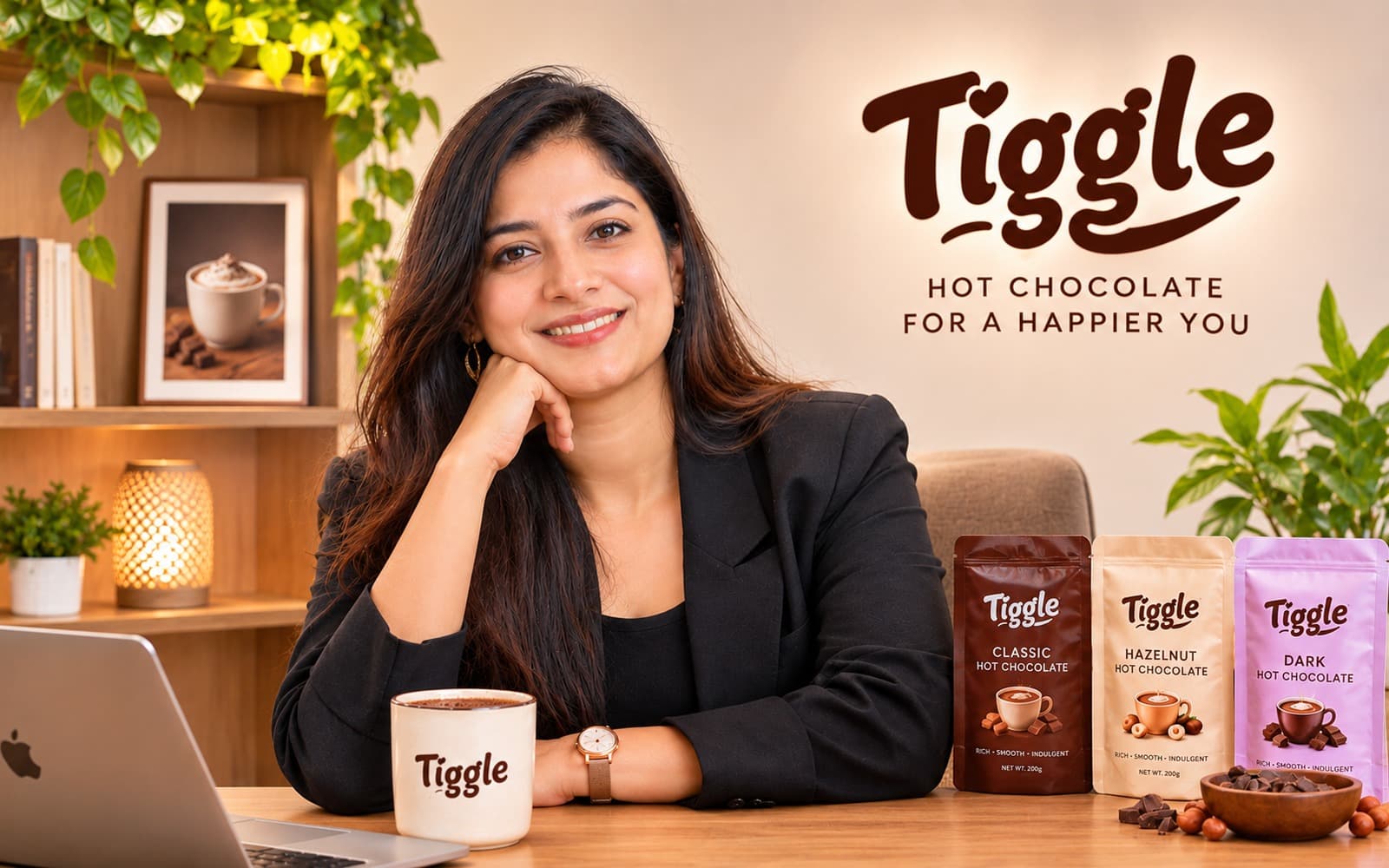
Tiggle: From a ₹35,000 Investment to Building a Growing Hot Chocolate Brand
How Anuva Kakkar turned a personal love for hot chocolate into Tiggle, an Indian direct-to-consumer brand that took an overlooked beverage category from a roadside experiment to Shark Tank India.
In this story14 sections
- 1.1. The Craving That Started a Business
- 2.2. From a Five-Litre Jar to the First 30 Cups
- 3.3. When the Pandemic Forced a Business Reinvention
- 4.4. Building Tiggle Online with ₹35,000
- 5.5. Finding the Right Cocoa: The Importance of Product Quality
- 6.6. Creating a Brand Around More Than One Flavour
- 7.7. Community-Led Marketing: Turning Customers into Tigglers
- 8.8. Building Manufacturing in Agra and Creating a Women-Led Team
- 9.9. From 200,000 Cups to Millions: The Growth of Tiggle
- 10.10. The Shark Tank India Moment
- 11.11. Expanding the Hot Chocolate Experience
- 12.12. The Business Challenges Behind the Success
- 13.13. What Entrepreneurs Can Learn from Anuva Kakkar's Journey
- 14.From a ₹35,000 Investment to a Growing Hot Chocolate Brand
Some businesses begin with a detailed market study, a team of investors and a carefully prepared business plan. Others begin with a simple frustration: wanting something that is difficult to find.
For Anuva Kakkar, the idea behind Tiggle started with a craving for a good cup of hot chocolate.
As a young graduate living in Gurugram, she loved the drink but found that a satisfying cup was mostly available in cafés. It was expensive to enjoy regularly, while the instant mixes available in the market did not deliver the rich chocolate experience she wanted.
Instead of accepting the gap, she decided to explore it as a business opportunity.
What followed was an unconventional entrepreneurial journey: selling freshly prepared hot chocolate outside a metro station, shutting down the original business model during the pandemic, experimenting with cocoa and recipes, and eventually launching a ready-to-make hot chocolate brand online.
With a reported initial investment of ₹35,000 for the direct-to-consumer launch, Anuva built Tiggle around one focused idea: making good hot chocolate accessible to more people in India.
The brand later appeared on Shark Tank India, where it secured investment from Peyush Bansal and Amit Jain.
Tiggle's story is a reminder that a seemingly small consumer problem can become the starting point of a scalable business when the founder understands the customer, tests the idea and adapts when circumstances change.
1. The Craving That Started a Business
Anuva Kakkar's entrepreneurial journey began with an everyday experience.
After completing her BBA from Banasthali University in 2019, she moved to Gurugram and worked at UrbanClap, now known as Urban Company. Like many young professionals, she enjoyed spending time with friends and exploring cafés.
But she noticed something missing from the everyday beverage market.
Coffee and tea were easily available, while good hot chocolate was largely associated with cafés and premium menus. For a young professional on a limited budget, enjoying it regularly was not practical.
She also felt that readily available instant mixes did not provide the richness and quality she expected from hot chocolate.
The question that stayed with her was simple: why should a good cup of hot chocolate be difficult or expensive to enjoy at home?
Anuva began exploring whether there was an opportunity to create an affordable product that could deliver a café-style experience without requiring customers to visit a café.
This was the beginning of Tiggle.
Her idea was not based on inventing a new beverage. It was about making an existing experience more accessible to Indian consumers.
2. From a Five-Litre Jar to the First 30 Cups
Before developing an online brand, Anuva wanted to know whether people would actually pay for her hot chocolate.
Rather than spending heavily on manufacturing, packaging or advertising, she decided to test the product directly with customers.
In 2019, she purchased a five-litre steel jar, three litres of milk and the ingredients required to prepare hot chocolate. She printed pamphlets and set up a small selling point outside the DLF Phase-3 metro station in Gurugram.
It was a simple experiment, but an important one.
Standing outside a metro station and selling a new beverage was not easy, particularly for a young woman trying to convince strangers to try an unfamiliar product.
However, the response exceeded her expectations.
According to Anuva's account in YourStory, she sold approximately 30 cups in just 52 minutes.
That first successful selling session gave her confidence that the idea deserved further exploration.
She subsequently partnered with a metro kiosk and sold more than 1,000 cups, using customer feedback to understand preferences and demand.
The experiment helped her answer an important business question: people were interested in hot chocolate when it was accessible, affordable and enjoyable.
For an early-stage founder, this kind of direct customer validation can be more valuable than an elaborate business presentation.
3. When the Pandemic Forced a Business Reinvention
Anuva's original business model focused on preparing fresh hot chocolate and supplying it to cafés and kiosks.
But in early 2020, the COVID-19 pandemic disrupted the food service and hospitality industries. Cafés closed, public movement was restricted and the business she had started just months earlier could no longer operate as planned.
The timing was particularly difficult.
Anuva had been pitching her product to cafés shortly before the first nationwide lockdown in India. Suddenly, the very locations she had hoped would become her customers were shut.
She returned to her hometown, Agra, and had to reconsider the future of Tiggle.
Many early-stage businesses might have stopped at this point. But Anuva began asking a different question:
If customers cannot visit a café for hot chocolate, could the café experience be brought into their homes?
This became the turning point.
Instead of selling freshly prepared drinks, she began working on a ready-to-make hot chocolate mix that customers could prepare themselves.
The change transformed Tiggle from a location-dependent beverage experiment into a product that could be packaged, shipped and sold across India.
The pandemic had closed the original route to market, but it also pushed the business towards a model with much greater geographical reach.
4. Building Tiggle Online with ₹35,000
The next phase required Anuva to learn an entirely different side of entrepreneurship.
She had experience selling freshly prepared drinks, but a direct-to-consumer food brand required product formulation, packaging, pricing, marketing, customer acquisition and logistics.
According to YourStory's January 2022 profile, Anuva launched the online version of Tiggle with an initial investment of ₹35,000.
She used the lockdown period to understand how to reach her target customers, position a product online, run advertisements and develop packaging that would appeal to young consumers.
The initial operation was extremely lean. Rather than beginning with a large team or expensive infrastructure, she focused on getting the product ready and reaching customers through digital channels.
The company's own current founder story separately recalls an initial investment of ₹20,000 for the original roadside stall in 2019. These are two different stages: the ₹20,000 street-selling experiment and the ₹35,000 investment reported for the online business.
This distinction is important because it shows how Tiggle evolved in stages:
-
First, validate demand through direct selling.
-
Then, develop a product that could be prepared at home.
-
Finally, build an online brand capable of reaching customers beyond one city.
It was a small investment, but it required Anuva to take responsibility for almost every part of the early business.
5. Finding the Right Cocoa: The Importance of Product Quality
For a brand built around one beverage category, product quality could not be an afterthought.
Anuva understood that Tiggle would have little chance of building repeat customers if its hot chocolate did not taste noticeably different from ordinary instant drink mixes.
She began researching cocoa and experimenting with different sources and formulations.
In interviews, she has described tasting cocoa from approximately 40–50 farms in India before identifying suitable sourcing partners.
The brand eventually established a sourcing relationship with cocoa farmers in Pollachi, Tamil Nadu.
The cocoa is transported to the manufacturing operation in Agra, where it is processed into the hot chocolate mixes.
This farm-to-product relationship became an important part of Tiggle's brand identity.
It also gave the company a way to differentiate itself in a market where many beverage mixes compete primarily through flavour, price and convenience.
Rather than treating cocoa as just another ingredient, Anuva placed it at the centre of the product experience.
The focus was on creating a richer, more chocolate-forward drink that customers could prepare conveniently at home.
6. Creating a Brand Around More Than One Flavour
Tiggle's early product development focused on making hot chocolate convenient without losing the experience of a freshly prepared drink.
The brand began developing different variants to serve customers with different preferences.
Its early range included dark hot chocolate, light hot chocolate and jaggery hot chocolate.
The jaggery variant was particularly interesting because it offered an alternative sweetening approach and was developed with feedback from the brand's online community.
Anuva involved customers in the product development process, asking them to participate in flavour discussions, tasting and packaging decisions.
This approach helped turn customers into contributors to the brand.
The community was not simply asked to purchase finished products. It was invited to help shape what the company created next.
In 2022, the brand introduced a hazelnut hot chocolate variant made with real hazelnuts and a dark chocolate base. According to the Protein Foods and Nutrition Development Association of India's December 2022 bulletin, the first production run reportedly sold out within 24 hours of launch.
The product strategy reflected a clear principle: rather than expanding into unrelated food categories, Tiggle wanted to explore the possibilities within chocolate beverages.
7. Community-Led Marketing: Turning Customers into Tigglers
One of the interesting aspects of Tiggle's growth was the way Anuva approached digital marketing.
For a young brand with limited capital, competing with established food companies through large advertising budgets was not realistic.
Instead, she focused on building a community around the product.
Social media became a way to share the company's progress, introduce new flavours, collect customer feedback and involve people in decisions.
The brand's customers became known as Tigglers, a name that reflected the playful identity of the company.
Anuva also used Facebook and Google advertising to reach new audiences. In her 2022 YourStory interview, she said Facebook campaigns had helped the brand reach more than two million people in a month.
The community approach was especially useful during new product development.
For the jaggery hot chocolate, a group of approximately 150 community members participated in discussions, tasting and feedback.
This helped the brand understand what its customers wanted instead of relying entirely on internal assumptions.
The lesson was simple: a small consumer brand does not always need to outspend larger competitors. It can build a closer relationship with its customers and make them part of the journey.
8. Building Manufacturing in Agra and Creating a Women-Led Team
As demand increased, Tiggle needed to develop a more consistent manufacturing process.
The company established its manufacturing operation in Agra, Uttar Pradesh, allowing it to produce and pack hot chocolate mixes for online orders.
Anuva's approach also included building a women-led production team.
In its current official story, Tiggle describes its products as being made by an all-women team in Agra.
This is an important part of the brand's identity because it connects the company's growth with employment and the people involved in making its products.
For a food business, manufacturing is not simply about increasing output. It also requires attention to ingredient quality, consistency, hygiene, packaging and fulfilment.
The move from a small home-based online operation to a more organised manufacturing setup marked another important stage in Tiggle's development.
It showed that the business was moving beyond founder-led experimentation towards a repeatable operating model.
9. From 200,000 Cups to Millions: The Growth of Tiggle
Tiggle's early growth was measured not only through online orders but also through the number of cups customers could prepare using its mixes.
In January 2022, YourStory reported that the brand had reached more than 14,000 customers and delivered approximately 200,000 cups of hot chocolate across more than 20,000 pin codes, according to Anuva.
These were significant milestones for a business that had started with a small roadside experiment.
The brand continued developing its product range and online presence. It also invested in manufacturing capacity to support growing demand.
In its current official founder story, Tiggle says it has served more than 5 million cups across India.
This is a company-reported milestone rather than an independently audited sales figure, but it illustrates the scale the brand says it has reached since its early days.
The journey from selling 30 cups outside a metro station to building a brand with millions of cups served demonstrates the potential of a focused direct-to-consumer business.
10. The Shark Tank India Moment
One of the biggest public milestones in Anuva's entrepreneurial journey came with her appearance on Shark Tank India Season 3.
Her pitch introduced Tiggle to a much larger audience and gave her an opportunity to explain the business, its products and its growth potential to experienced investors.
Anuva entered the show seeking ₹50 lakh for 5% equity, valuing the business at ₹10 crore.
After discussions and negotiations, she secured a deal with two investors:
-
Peyush Bansal
-
Amit Jain
The final deal was ₹50 lakh for 20% equity, along with a 2% royalty until ₹1 crore was recovered, as reported in the show's pitch coverage and Tiggle's own company story.
The deal valued the business at a substantially lower level than Anuva's original asking valuation, but it brought two experienced entrepreneurs into the company's growth journey.
For Tiggle, the appearance was about more than investment. It provided national visibility, introduced the brand to new consumers and brought attention to the hot chocolate category.
It was a major moment for a founder who had once stood outside a metro station trying to convince strangers to buy her first cup.
11. Expanding the Hot Chocolate Experience
Tiggle's strategy has been to go deeper into chocolate beverages rather than become a general food and beverage company.
The company has continued experimenting with flavours, cocoa intensity and formats to serve different preferences.
One notable development was its 55% Dark Iced Chocolate, which founder Anuva highlighted in an April 2024 LinkedIn post as a summer product that generated significant revenue during the warmer months.
The launch demonstrated that hot chocolate could be developed into a year-round category rather than remaining a beverage associated only with winter.
The brand's wider product direction has included:
-
Dark hot chocolate.
-
Light hot chocolate.
-
Jaggery hot chocolate.
-
Hazelnut hot chocolate.
-
Iced chocolate.
-
Higher-cocoa-content chocolate drink options.
The company's focus on chocolate beverages gives it a clear product identity. Instead of spreading its resources across unrelated categories, it is exploring different ways people can enjoy chocolate as a drink.
This is a useful strategy for a specialist food brand: build recognition around one category first, then expand through products that strengthen the same identity.
12. The Business Challenges Behind the Success
Tiggle's journey may appear straightforward when viewed through its milestones, but the business faced several challenges along the way.
Building trust in an unfamiliar category
Hot chocolate was not an everyday beverage for many Indian consumers. Anuva had to introduce the product, explain its preparation and convince customers that it was worth purchasing.
Finding the right product formulation
The difference between a basic chocolate drink and a satisfying hot chocolate depends on cocoa quality, sweetness, texture and preparation. Developing a consistent product required research and experimentation.
Managing the pandemic
The original café and kiosk business became impossible during lockdown. The company had to shift its entire model towards packaged products and online distribution.
Convincing suppliers and business partners
Anuva has spoken about the difficulties of being taken seriously as a young woman entrepreneur, particularly when dealing with vendors, factory arrangements and manufacturing equipment.
Scaling without losing product quality
As orders increased, the business needed more organised manufacturing, sourcing and fulfilment systems.
These challenges reveal an important aspect of entrepreneurship: a successful product idea is only the beginning. Building a sustainable business requires solving operational problems repeatedly as the company grows.
13. What Entrepreneurs Can Learn from Anuva Kakkar's Journey
Anuva's experience offers several practical lessons for people who want to build consumer brands.
1. Start with a problem you understand.
Tiggle began with a personal craving and a gap Anuva experienced herself. This gave her a clear understanding of the customer problem.
2. Test demand before investing heavily.
Selling hot chocolate outside a metro station helped her validate interest before developing a packaged product.
3. Treat setbacks as opportunities to rethink the business.
The pandemic ended the original kiosk model, but it encouraged the shift to a direct-to-consumer product.
4. Product quality creates repeat customers.
Tiggle's focus on cocoa sourcing, formulation and experimentation helped it build a distinct product identity.
5. Involve customers in product development.
The brand's community-led approach gave customers a voice in new flavours and product decisions.
6. Build a focused brand identity.
Rather than expanding into unrelated food categories, Tiggle has concentrated on chocolate beverages.
7. Do not underestimate small beginnings.
A small roadside experiment can become the foundation of a much larger business when the founder is willing to learn, adapt and keep improving.
From a ₹35,000 Investment to a Growing Hot Chocolate Brand
Anuva Kakkar's journey is an example of how an ordinary consumer experience can become the foundation of an entrepreneurial opportunity.
She did not begin with a large factory, an established food brand or a network of investors. She began with a craving, a five-litre jar and the willingness to sell a product directly to strangers.
When the pandemic disrupted her original business model, she did not abandon the idea. She changed the way customers could experience it.
That decision led to the online launch of Tiggle, a brand built around cocoa sourcing, product development, community participation and convenient hot chocolate mixes.
Its appearance on Shark Tank India brought national attention, while its reported growth to millions of cups served reflects the scale of the opportunity Anuva identified.
Perhaps the most important part of her story is that she did not try to build another general food brand. She chose a relatively unexplored category and worked to make it more accessible.
Tiggle's story shows that sometimes the next business opportunity is hiding in something people already love—but cannot easily find, afford or enjoy.
More Food & Beverage stories
Open Secret: How a Mother’s Search for Better Children’s Snacks Inspired a Business That Wants to Un-Junk India
From a familiar problem in Indian family kitchens to a growing better-for-you food brand, Open Secret is challenging the idea that convenient packaged snacks must come with a compromise on ingredients.
Read story
Tilda Rice: How an Indian Entrepreneur Built a Global Basmati Rice Business
From a family displaced from Uganda to a household name in British kitchens, the Thakrar family's journey shows how cultural knowledge, product quality and a long-term export vision helped turn basmati rice into an international food brand.
Read story
Shuddh Dairy: How Indian Entrepreneurs Brought Traditional Dairy Products to Sydney
From a banking career to building an Australian dairy manufacturing business, Harman Singh's journey began with a simple market insight: Indian families in Australia wanted fresh, authentic paneer, dahi, ghee and traditional dairy products made closer to home.
Read story