
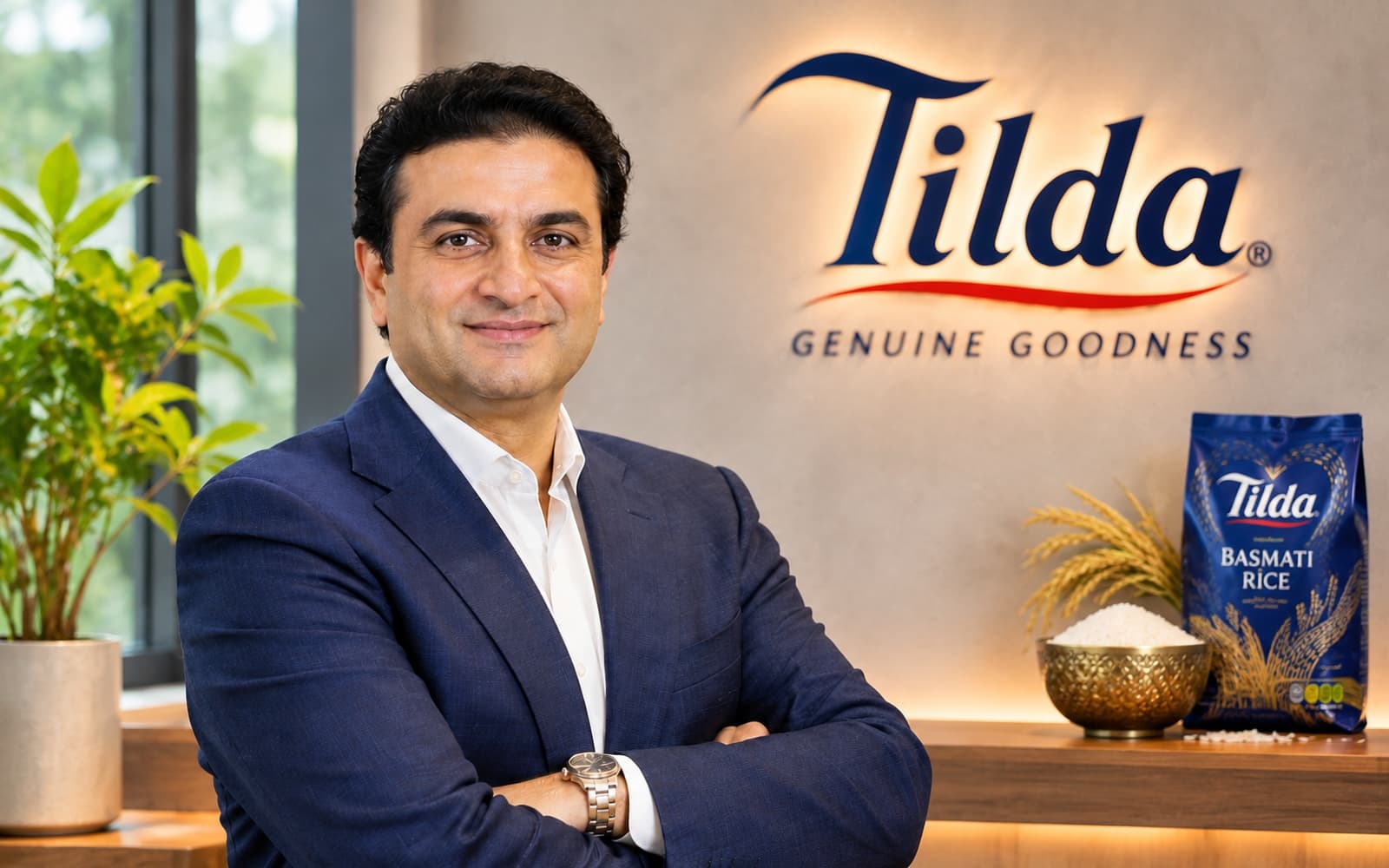
Tilda Rice: How an Indian Entrepreneur Built a Global Basmati Rice Business
From a family displaced from Uganda to a household name in British kitchens, the Thakrar family's journey shows how cultural knowledge, product quality and a long-term export vision helped turn basmati rice into an international food brand.
In this story18 sections
- 1.A journey that began far from Britain
- 2.The entrepreneur behind the Tilda story
- 3.Uganda: The business lessons before Tilda
- 4.The opportunity in Britain's immigrant communities
- 5.The birth of Tilda
- 6.Why quality became the company's competitive advantage
- 7.From a community business to a mainstream British brand
- 8.Building the supply chain between India and Britain
- 9.The Rainham facility: investing in British operations
- 10.International expansion: taking basmati beyond Britain
- 11.Packaging and product innovation
- 12.The 2014 acquisition: a new chapter for Tilda
- 13.The 2019 acquisition by Ebro Foods
- 14.The brand's commitment to quality and responsible sourcing
- 15.A social commitment through the World Food Programme
- 16.What Tilda's journey teaches entrepreneurs
- 17.The legacy of Tilda
- 18.Founder profile
A journey that began far from Britain
In the early 1970s, the Thakrar family arrived in Britain carrying more than their personal belongings. They brought with them a deep connection to Indian food, business experience developed in East Africa, and an understanding of a product that millions of families already valued: aromatic basmati rice.
The family's journey was shaped by the upheaval experienced by Uganda's Asian community under Idi Amin. Following the expulsion of Asians from Uganda in 1972, many families were forced to rebuild their lives in new countries. The Thakrars became part of this migration, settling in Britain and looking for an opportunity to start again.
For Narsi Bhai Thakrar, the challenge was not entirely unfamiliar. He had already spent decades building trading businesses in East Africa. But Britain presented a different market, a different consumer landscape and a new opportunity.
The family recognised that South Asian immigrants wanted the ingredients and flavours they knew from home. Among these essentials was pure, aromatic basmati rice.
What began as a business serving a community with a familiar food preference eventually became the foundation of Tilda, one of Britain's best-known rice brands.
The entrepreneur behind the Tilda story
Narsi Bhai Thakrar, also referred to in historical records as Narshidas Thakrar, was not a first-time entrepreneur when he arrived in Britain.
His business experience began much earlier in East Africa. Born into a family with limited financial resources, he travelled to Uganda in 1937 to work for the Mehta group. He started in an accounts role and later became a manager at a ginnery in Hoima.
In 1945, he entered a business partnership with Ranchodbhai Popat, taking over an existing trading business. The venture developed into Popat Brothers Ltd, formed in 1949, with operations involving groceries and the importation of goods such as rice, salt and roofing materials.
His business experience was built through trading, distribution, warehousing and relationships with suppliers. These capabilities would become valuable when he later entered the British food market.
The Thakrar family's story is therefore not simply one of starting from nothing. It is a story of an experienced trading family having to rebuild its commercial life after political upheaval.
Uganda: The business lessons before Tilda
Before Tilda became a British brand, the Thakrar family had established itself in Uganda's trading economy.
The family operated warehouses and trading premises and became a major importer of rice, salt and corrugated iron sheets. In an account reproduced by Uganda's Daily Monitor from Narshidas Thakrar's 1995 wedding anniversary speech, he recalled that the family had become responsible for a substantial share of Uganda's imports in these categories.
However, government policy changed the trading environment. In 1967, the Ugandan government restricted the importation of rice and salt through a national trading company. The family consequently faced a difficult business environment.
The political and economic situation continued to change. In 1972, Idi Amin's regime expelled Uganda's Asian population, forcing thousands of families to leave their homes, businesses and established lives.
For the Thakrars, Britain became the place to rebuild.
Their earlier experience had taught them something important: trading success depended on more than identifying a product. It required dependable sourcing, quality, distribution and the ability to understand what customers wanted.
The opportunity in Britain's immigrant communities
When the family began its British business, its initial customer base was relatively clear.
Indian, Pakistani and Bangladeshi households wanted the rice varieties they had grown up eating. Basmati was not simply another grocery product. It was central to biryani, pulao and many traditional meals.
At the time, the availability of authentic, consistently high-quality basmati rice in Britain was limited compared with what consumers expected from South Asia.
The Thakrars saw an opportunity to bridge that gap.
They began by supplying rice to the South Asian community, building their reputation around the quality of the grains. The family understood that consumers who knew basmati well would notice broken grains, impurities, inconsistent cooking performance and poor packaging.
Rather than competing only on price, they focused on quality.
The business initially involved cleaning, sorting and packing rice and pulses. The family's attention to the condition of the grains helped it build a reputation among customers who were particular about the rice they bought.
A particularly important development came when the family realised that the opportunity was not limited to immigrant households.
British consumers were increasingly discovering Indian food. Restaurants, supermarkets and changing food habits were introducing a wider audience to dishes that relied on aromatic rice.
The market could be much larger than the community that first supported the business.
The birth of Tilda
Tilda was founded in 1970, according to the company's official history.
The brand's name carries a personal family connection. It combines the names of two daughters of the founders: Tila and Daksha.
The choice of name helped create a distinctive identity for a product that might otherwise have been sold as a commodity.
Rice is a staple food, and consumers can often find multiple brands offering similar varieties. Building a recognisable brand around it required a clear promise.
For Tilda, that promise was quality basmati rice.
The company introduced aromatic basmati rice to a wider Western audience and positioned itself around the purity and quality of its grains. Its official history describes the brand as one of the first to introduce high-quality aromatic basmati rice to Western consumers.
The strategy was commercially important. Instead of treating rice as an interchangeable bulk commodity, Tilda presented it as a product with origin, aroma, cooking characteristics and quality standards worth paying attention to.
Why quality became the company's competitive advantage
One of the most important decisions in Tilda's development was its focus on grain quality.
Basmati rice is valued for its distinctive aroma, long grains and cooking characteristics. Consumers who regularly prepare it often have strong expectations about how the grains should look and behave after cooking.
Maintaining those characteristics consistently requires attention throughout the supply chain.
The Thakrar family understood that poor-quality rice could damage the brand quickly. It therefore invested in processes that helped maintain consistency.
Historical accounts of the business describe the family's emphasis on cleaning and sorting rice, removing broken grains and ensuring that the product was packed neatly.
The family also invested in technology. An account by Narshidas Thakrar's son, Vipul, published by Uganda's Daily Monitor, describes the installation of a colour-sorting machine to improve grain quality and support the company's promise of pure basmati.
This was a significant step in a market where visual consistency and product purity helped distinguish premium rice from lower-priced alternatives.
The business was moving beyond simply buying and selling rice. It was developing a quality-controlled food brand.
From a community business to a mainstream British brand
The next stage of Tilda's growth came from a shift in how Britain consumed food.
During the 1980s, Indian food became increasingly popular across the country. Curry restaurants expanded, supermarkets introduced more international ingredients and consumers became more comfortable preparing dishes influenced by South Asian cuisines at home.
Rice became an important part of this change.
Tilda benefited from the growing popularity of Indian cooking while also helping make authentic basmati more accessible.
Its brand was no longer relevant only to families who had migrated from South Asia. It was becoming familiar to British households discovering the cuisine.
This transition illustrates an important lesson in consumer-brand building: a business can begin by serving a clearly defined community, but long-term growth often comes from understanding how the wider market is changing.
Tilda did not need to abandon its cultural roots to reach new customers. Its Indian food heritage became part of the brand's appeal.
Building the supply chain between India and Britain
A global rice brand needs a dependable supply chain.
For Tilda, the connection to India was particularly important because basmati is closely associated with the agricultural regions of the Indian subcontinent.
The Thakrar family's business interests extended beyond the British brand. The family established United Riceland Limited in Samana, Haryana, in 1981 to export brown basmati rice to the United Kingdom.
The International Finance Corporation's project records describe United Riceland as a premium basmati rice miller and exporter established by the Thakrar family. The company supplied markets in the European Union and the Middle East, alongside the Indian domestic market.
The records also document investment in modern milling capacity and a facility in Gurgaon, Haryana.
This development is important to understanding the wider business strategy. The family was not only building a consumer-facing brand in Britain; it was also investing in the Indian side of the rice value chain.
Such a structure could provide greater control over sourcing, milling, processing and export operations.
It also connected British consumer demand with agricultural and manufacturing capabilities in India.
The Rainham facility: investing in British operations
As Tilda grew, the company invested in its own UK infrastructure.
In 1988, Tilda relocated to Rainham, near London on the Thames Estuary, where it built a rice mill and packing facility.
The site became a central part of the company's operations and remains an important location for Tilda.
Having a dedicated milling and packing facility helped the company strengthen its control over processing and product consistency.
It also supported the development of a broader product range and the ability to supply larger retail customers.
For a food company, manufacturing and packaging are not merely back-office functions. They influence quality, efficiency, shelf life, supply reliability and ultimately the consumer experience.
Tilda's investment in Rainham reflected a shift from a family trading operation into a more sophisticated food manufacturing and distribution business.
International expansion: taking basmati beyond Britain
By the 1990s, Tilda had begun expanding into the Middle East and North America.
The international opportunity was supported by the growing popularity of Indian and other global cuisines, as well as demand from communities living outside their countries of origin.
The brand's appeal was also broader than a single ethnic market. Basmati rice could be used in a wide range of dishes, from traditional South Asian meals to contemporary international recipes.
Tilda's official history says that the brand now reaches dinner tables in more than 50 countries.
The company's expansion demonstrated how a culturally specific product could become an international grocery brand when supported by consistent quality, distribution and brand recognition.
Packaging and product innovation
Tilda's growth was not limited to expanding its geographical reach.
The company also developed packaging and product innovations that responded to changing consumer expectations.
During the 2000s, Tilda introduced packaging features such as easy-to-carry handles and resealable zips designed to help preserve freshness.
It also moved beyond traditional dry rice.
In 2010, the company opened a production facility in Rainham for its steamed rice, Super Grains and Kids ranges. These products addressed consumers looking for convenience, variety and faster meal preparation.
Ready-to-heat rice became particularly relevant to modern households where time and convenience increasingly influenced food purchasing decisions.
This expansion showed that a traditional staple could support a much wider product strategy.
The company was no longer relying exclusively on bags of dry basmati rice. It was building a portfolio that could serve different cooking occasions and consumer needs.
The 2014 acquisition: a new chapter for Tilda
After more than four decades of family ownership, Tilda entered a new phase in January 2014.
The Hain Celestial Group announced its acquisition of Tilda, describing it as a leading premium branded basmati and speciality rice business.
At the time of the announcement, Tilda offered more than 60 dry rice and ready-to-heat products under brands including Tilda, Akash Basmati and Abu Shmagh.
The company reported approximately US$190 million in net sales for calendar year 2013 and supplied consumers in more than 40 countries.
The acquisition was reported at approximately £217 million.
For the Thakrar family, the transaction represented a major milestone after decades of building the business.
For Tilda, it provided access to the resources and international platform of a larger food company.
The sale also demonstrated the commercial value of transforming a staple food product into a differentiated international brand.
The 2019 acquisition by Ebro Foods
Tilda's ownership changed again in 2019, when it was acquired by Ebro Foods, a Spanish food group and one of the world's largest rice and pasta businesses.
Ebro's acquisition placed Tilda within a global rice-focused organisation with extensive experience in sourcing, processing, manufacturing and distribution.
The change in ownership did not erase the brand's British identity. Tilda continued to operate from the UK and remained closely associated with its Rainham base.
The company's official history identifies 2019 as the year it became part of Ebro Foods.
Today, Tilda operates as part of the Ebro Foods group, while continuing to serve consumers in the UK and international markets.
The brand's commitment to quality and responsible sourcing
As the food industry has become more focused on sustainability, agricultural practices and supply-chain transparency, Tilda has also highlighted its work with farmers and responsible sourcing.
The company's 2023–24 Impact Report states that Tilda supports the livelihoods of more than 2,700 rice farmers and employs over 300 people.
The report describes its efforts to work with farmers, improve agricultural practices and reduce the environmental impact of rice production.
Tilda also highlights DNA testing of basmati rice batches as part of its purity assurance programme.
These initiatives reflect a broader challenge for global food brands: maintaining product quality while responding to concerns about agriculture, water use, climate impact and supply-chain responsibility.
Rice production can be resource-intensive, making responsible cultivation and sourcing important long-term issues for the industry.
Tilda's work in this area is part of the brand's current operating story, rather than a claim that every sustainability challenge has been solved.
A social commitment through the World Food Programme
Tilda's brand history also includes a long-running partnership with the United Nations World Food Programme.
The partnership began in 2012. Under the initiative, purchases of specially marked Tilda Pure Basmati Rice packs helped fund nutrition-boosting meals for new and expectant mothers.
Tilda's official history reports that the partnership has delivered 5.8 million nutrition-boosting meals.
This initiative connected the company's food business with a wider social objective: supporting maternal nutrition.
For a brand whose identity is built around food and family meals, the partnership provided another way to connect commercial activity with a social contribution.
The impact figure is reported by the company and should be attributed accordingly.
What Tilda's journey teaches entrepreneurs
Tilda's history offers important lessons for entrepreneurs, particularly those building food, export and consumer-product businesses.
1. Start with a market you understand.
The Thakrar family understood the importance of basmati rice to South Asian households. That cultural knowledge helped them identify an initial customer base and a product with established demand.
2. Do not limit the business to its first customer group.
The family recognised that basmati could appeal to mainstream British consumers as Indian food became more popular. Expanding beyond the initial community created a much larger opportunity.
3. Quality can differentiate a commodity.
Rice is widely available, but consistent aroma, grain purity, processing and packaging can create a premium brand.
4. Build control into the supply chain.
The family's investments in Indian milling and British processing helped connect sourcing with the consumer market. This is an important lesson for businesses that depend on imported agricultural products.
5. Invest in infrastructure when the market demands it.
The Rainham facility was a major step in Tilda's development. Reliable manufacturing and packing capabilities helped the business grow beyond a small trading operation.
6. Innovation can extend the life of a traditional product.
Tilda's move into steamed rice, ready-to-heat products and speciality grains shows how an established food category can evolve with changing lifestyles.
7. Build a brand that can outlast its founders.
The eventual acquisitions by Hain Celestial and Ebro Foods demonstrate how a family-built business can develop into an international brand with value beyond its original ownership.
The legacy of Tilda
Tilda's story began with a family that understood the importance of familiar food.
The Thakrars arrived in Britain during a period of extraordinary change. They had to rebuild their lives and business interests in a new country, but they recognised an opportunity in something deeply connected to their heritage.
By focusing on authentic basmati rice, consistent quality, processing and packaging, they created a brand that reached far beyond its original customer base.
The company expanded internationally, invested in manufacturing, developed new product categories and eventually became part of two major global food groups.
Its journey is a powerful example of how an entrepreneur's understanding of a community can become the foundation of a much larger business.
Tilda did not make basmati rice popular by changing what it was. It built a business by helping more people discover the quality, aroma and versatility that had made the rice important to families for generations.
From Uganda to Britain, and from a family trading business to an international rice brand, the Thakrar family's journey is a story of resilience, cultural identity and the global potential of a product rooted in tradition.
Founder profile
Narsi Bhai Thakrar (also known as Narshidas Thakrar)
Narsi Bhai Thakrar was an Indian-origin entrepreneur whose business journey began in East Africa before he helped establish the Thakrar family's rice business in Britain. After building trading operations in Uganda, the family relocated to the UK in the early 1970s amid the expulsion of Uganda's Asian community. The family founded Tilda in 1970, introducing premium aromatic basmati rice to a wider British market and building a business that later expanded internationally.
Business: Tilda Rice
Founded: 1970
Origin: United Kingdom
Industry: Rice, Food Manufacturing and Exports
Original ownership: Thakrar family
Acquired by: Hain Celestial in 2014; Ebro Foods in 2019
Current group: Ebro Foods
More Food & Beverage stories

Tiggle: From a ₹35,000 Investment to Building a Growing Hot Chocolate Brand
How Anuva Kakkar turned a personal love for hot chocolate into Tiggle, an Indian direct-to-consumer brand that took an overlooked beverage category from a roadside experiment to Shark Tank India.
Read story
Open Secret: How a Mother’s Search for Better Children’s Snacks Inspired a Business That Wants to Un-Junk India
From a familiar problem in Indian family kitchens to a growing better-for-you food brand, Open Secret is challenging the idea that convenient packaged snacks must come with a compromise on ingredients.
Read story
Shuddh Dairy: How Indian Entrepreneurs Brought Traditional Dairy Products to Sydney
From a banking career to building an Australian dairy manufacturing business, Harman Singh's journey began with a simple market insight: Indian families in Australia wanted fresh, authentic paneer, dahi, ghee and traditional dairy products made closer to home.
Read story