
Open Secret: How a Mother’s Search for Better Children’s Snacks Inspired a Business That Wants to Un-Junk India
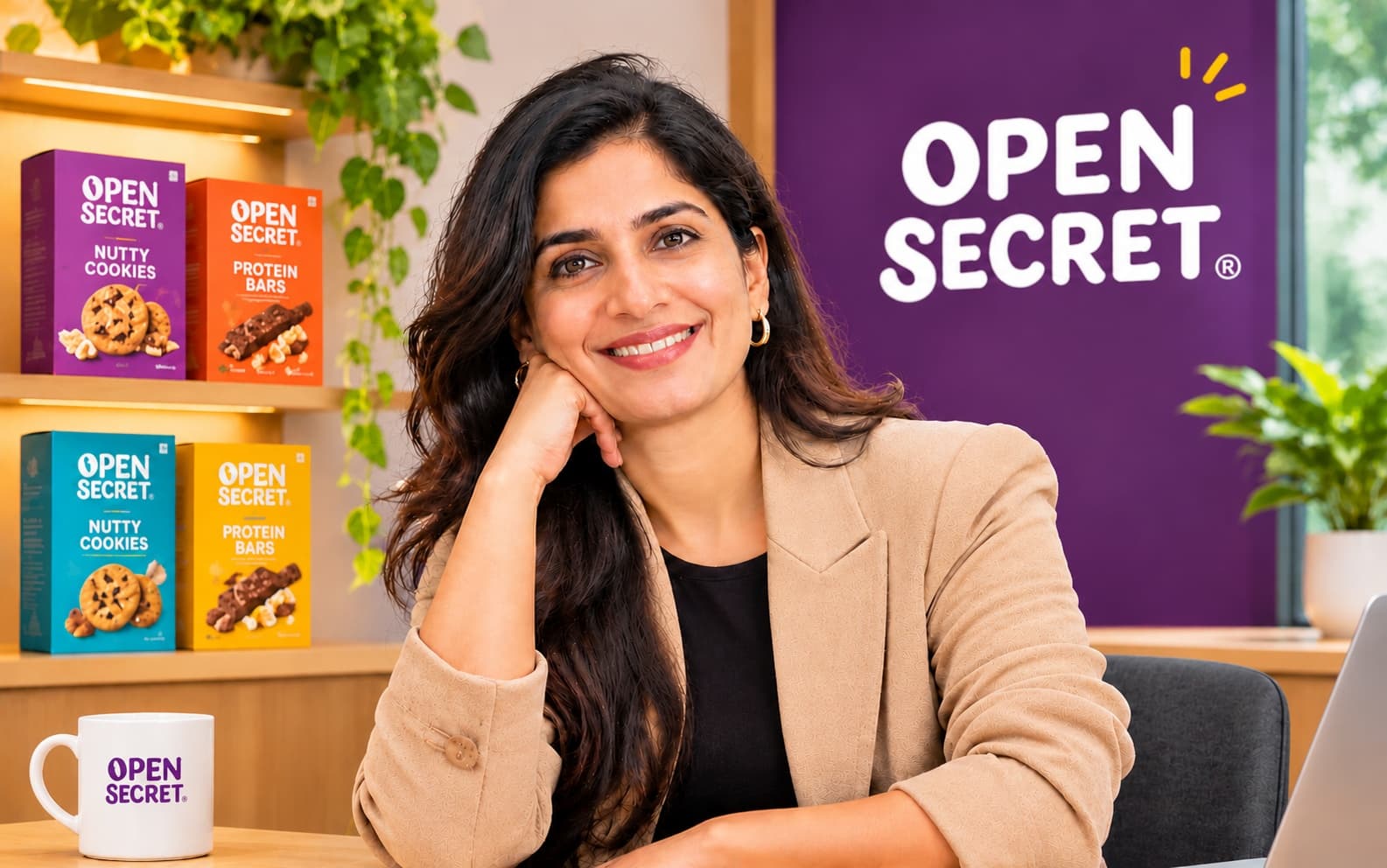
From a familiar problem in Indian family kitchens to a growing better-for-you food brand, Open Secret is challenging the idea that convenient packaged snacks must come with a compromise on ingredients.
In this story14 sections
- 1.The everyday problem behind the business
- 2.A founder’s personal connection to the problem
- 3.From corporate experience to entrepreneurship
- 4.Why they chose familiar snacks instead of a completely new category
- 5.The first product: Nutty Cookies
- 6.The manufacturing challenge: making the product at the required quality
- 7.The early investors who backed the idea
- 8.From cookies to a wider snacking portfolio
- 9.The meaning of “Un-Junking India”
- 10.Building a brand around mothers and families
- 11.Growth, distribution and the economics of a food brand
- 12.The 2026 funding milestone: the next phase of expansion
- 13.What Open Secret's journey teaches other founders
- 14.The road ahead
The everyday problem behind the business
For many parents, choosing a snack for a child can feel like a compromise. The convenient options are often the familiar biscuits, cookies, chips and packaged treats that children enjoy. But parents who want to pay closer attention to ingredients may find themselves reading labels, comparing products and still struggling to find something that is both appealing and convenient.
This everyday tension became the starting point for Open Secret.
Founded in 2019 by Ahana Gautam and Udit Kejriwal, Open Secret set out to make familiar Indian snacking choices with a different approach to ingredients. Rather than asking families to abandon the snacks they already enjoyed, the company wanted to rethink how those snacks were made.
Its central idea was simple: preserve the pleasure and familiarity of snacking while working to remove or reduce ingredients that many health-conscious consumers prefer to avoid.
The brand calls this mission “Un-Junking India.”
It is a story about food, but also about the realities of modern parenting, the influence of family, and the opportunity to build a consumer business around a problem that millions of households recognise.
A founder’s personal connection to the problem
Ahana Gautam’s interest in food and nutrition was shaped by her own childhood and family experiences.
Growing up in Bharatpur, Rajasthan, she has spoken about her relationship with food and the unhealthy snacking habits she developed as a child. Her experiences later influenced the way she thought about food choices, health and the products available to Indian families.
Her mother played a particularly important role in her life. A single parent who encouraged Ahana to pursue ambitious educational and professional goals, she became a source of confidence and inspiration.
Ahana has repeatedly credited her mother for giving her the courage to challenge expectations and pursue opportunities that were not always considered conventional for women from smaller Indian cities.
That influence became part of Open Secret’s identity. The company’s own story describes the brand as a tribute to mothers and the role they play in shaping their children's lives.
But the business opportunity was not based on sentiment alone. It came from observing a practical gap in the market.
During her time at Harvard Business School in the United States, Ahana encountered supermarkets where families could choose from a much wider selection of better-for-you packaged foods. She began to question why Indian consumers had fewer convenient alternatives.
The contrast became more meaningful when she considered the challenges faced by her own family. Her sister-in-law struggled to find suitable packaged snacks for her daughter, despite wanting to make better food choices.
Ahana recognised that this was not an isolated problem. Many parents wanted healthier options, but they did not necessarily want to change their children's eating habits completely.
That observation helped shape the business proposition: make familiar snacks differently.
From corporate experience to entrepreneurship
Before starting Open Secret, Ahana had built an impressive corporate career.
She studied chemical engineering at the Indian Institute of Technology Bombay and later completed an MBA at Harvard Business School. Her professional experience included working at Procter & Gamble and General Mills, where she gained exposure to consumer products, supply chains, marketing and the food business.
At General Mills in the United States, she worked with natural and organic food products. This experience helped her understand how large food companies develop, position and distribute products for consumers.
Her co-founder, Udit Kejriwal, brought a complementary background. An IIT Kharagpur graduate with an MBA from IIM Ahmedabad, he had worked at Procter & Gamble and McKinsey, developing experience in operations and supply-chain management.
The combination mattered. Building a packaged-food company requires more than a good recipe. It involves product development, sourcing, manufacturing, quality control, distribution, pricing and brand building.
Ahana brought consumer and food-industry experience, while Udit contributed operational and strategic expertise.
Together, they began working on a business that would address a familiar consumer need through product innovation.
Why they chose familiar snacks instead of a completely new category
The Indian packaged-food market already had plenty of products positioned around health and nutrition. But the founders saw an opportunity to make everyday snacks more suitable for families without asking consumers to adopt unfamiliar eating habits.
A protein bar or a specialised nutrition product may appeal to a particular audience. A cookie, biscuit or snack, however, is already part of many households' routines.
The founders wanted to work within those existing habits.
In a December 2019 interview with The Times of India, Ahana described how parents often felt guilty about giving children packaged snacks because convenient, better-quality alternatives were difficult to find.
The team also recognised that taste could not be sacrificed. A product might have an attractive ingredient list, but if children did not enjoy eating it, parents were unlikely to buy it repeatedly.
This became one of the company's earliest product-development challenges: create snacks that could compete on taste and convenience while offering a different ingredient proposition.
The first product: Nutty Cookies
Open Secret entered the market with nutty cookies.
The initial product range was designed around the children's snacking opportunity, particularly the need for convenient options that parents could consider for school tiffins and everyday consumption.
The product-development process involved extensive experimentation. A 2020 YourStory profile reported that Ahana had tasted more than 1,000 cookies with different combinations while working towards the right formulation.
That detail reveals something important about the early business: the founders were not simply putting a health label on an existing snack. They were trying to solve a product-design problem.
The cookies needed to satisfy several requirements:
-
They had to taste good enough for children.
-
They needed to offer parents a more considered ingredient choice.
-
They had to be convenient and suitable for everyday snacking.
-
They needed to be commercially viable to manufacture and distribute.
Open Secret launched its first products in 2019, with the company registered in March of that year. Early retail availability included stores in Mumbai, while online marketplaces helped the brand reach customers beyond the city.
The first product gave the company a starting point. The bigger ambition was to create a brand that could extend across the wider snacking category.
The manufacturing challenge: making the product at the required quality
For a packaged-food startup, product development is only one part of the challenge. Turning a successful recipe into a consistent product at scale is another.
In its early days, Open Secret explored contract manufacturing options. However, the founders found it difficult to identify manufacturing partners who could meet the requirements of an early-stage business while maintaining the quality and flexibility they wanted.
This highlighted a common challenge for food startups: a product may work in small batches, but scaling it requires reliable processes, consistent ingredients, production capacity and quality control.
The founders had to think beyond the recipe and build a business capable of delivering the product repeatedly.
As the company developed, manufacturing and operational capabilities became important parts of its growth strategy.
The early investors who backed the idea
Open Secret attracted investor attention early in its journey.
In 2019, the company raised seed funding, with participation from investors including Vijay Shekhar Sharma, Kunal Bahl, Rohit Bansal and Vivek Gambhir, according to media reports.
The early investment helped the company build its product portfolio and strengthen its market presence.
In July 2021, Open Secret announced a Series A round led by Sixth Sense Ventures, with existing investor Matrix Partners India also participating. The company said it had experienced 10X growth over the preceding year.
At that point, its portfolio had expanded beyond cookies to include products such as chips, spreads, nuts and shake mixes.
In June 2022, the company raised a Series B round led by Ananta Capital, with participation from existing investors Sixth Sense Ventures and Matrix Partners India, as well as Gautam Kumra.
The funding milestones reflected investor interest in the broader opportunity: building a consumer food brand around everyday snacking rather than a narrow specialist nutrition category.
From cookies to a wider snacking portfolio
The original nutty cookies were the beginning, not the final destination.
Open Secret gradually expanded into multiple product categories, including:
-
Cookies and biscuits
-
Chips and savoury snacks
-
Nuts and flavoured nuts
-
Nut-based spreads
-
Chocolates
-
Shake mixes
-
Protein-focused snacks
-
Other packaged food and beverage products
The strategy was to bring the brand's ingredient philosophy into more of the occasions when families snack.
This was commercially significant. A consumer who discovers a brand through cookies may later purchase its chips, spreads or other products. A broader portfolio can create more opportunities for repeat purchases and increase the number of occasions on which the brand is relevant.
The company also moved beyond being only a product manufacturer. Its official website describes a wider platform that curates products from other food and beverage brands aligned with its Un-Junk mission.
The business has therefore evolved from a focused snack startup into a broader healthy-food and snacking destination.
The meaning of “Un-Junking India”
Open Secret's most recognisable positioning is its “Un-Junk” philosophy.
The idea is not to tell consumers that they should stop enjoying cookies, biscuits, chips or traditional snacks. Instead, the company aims to offer alternatives that retain familiar formats while changing the ingredients and preparation approach.
Its current product listings highlight claims such as no maida, no palm oil, no added preservatives, baked rather than fried, and no refined sugar in selected products.
These claims are product-specific. They should not be interpreted as meaning every item across the entire catalogue has the same nutritional profile or ingredient exclusions. Consumers should always check the label and nutritional information for the particular product.
This distinction is important in the better-for-you food market. “Healthy”, “natural” and “guilt-free” are broad marketing descriptions; the actual nutritional value of a product depends on its ingredients, portion size, sugar, fat, salt, fibre and overall formulation.
For Open Secret, the long-term opportunity lies in making its ingredient promise credible across a growing portfolio while maintaining the taste and convenience consumers expect.
Building a brand around mothers and families
The mother-child relationship is more than an origin-story detail for Open Secret. It is a central part of the brand's positioning.
The company's official story describes Open Secret as a tribute to mothers and the care they bring to family life. It also says that mothers from local communities play a role in overseeing products and that women are represented across its workforce and manufacturing operations.
The company has publicly described a workforce in which more than half of employees are women, including women working on the shop floor.
This creates a broader narrative around the business: a brand built to respond to the concerns of mothers while also creating employment opportunities for women.
The company's 2022 story highlighted a workforce of more than 50 mothers and women. Its official website has since described a wider network of products and partner brands, although company-reported figures should be treated as business claims rather than independently audited measures.
For consumers, the emotional connection is straightforward. Parents want to make better choices for their children without turning every snack into a negotiation.
Open Secret's proposition is to make that choice easier.
Growth, distribution and the economics of a food brand
Food is a high-frequency consumer category, but it is also operationally demanding.
A successful packaged-food business must balance product quality, shelf life, ingredient costs, manufacturing capacity, packaging, logistics, retailer margins and customer acquisition.
Open Secret's early expansion across online platforms and retail stores helped it build visibility beyond its initial Mumbai market.
Over time, the business expanded its product range and distribution strategy. Its 2021 Series A announcement referred to plans to increase manufacturing capacity and build an omnichannel presence.
The company's growth has also been reflected in its reported financial performance.
According to financial data cited by Moneycontrol in October 2026, Open Secret's standalone revenue increased from approximately ₹30 lakh in FY20 to ₹3.2 crore in FY21, ₹13.3 crore in FY22 and ₹38.3 crore in FY23. It then rose to approximately ₹56.9 crore in FY24 and ₹87.5 crore in FY25.
The same report said standalone net losses narrowed to approximately ₹7.2 crore in FY25, compared with around ₹23 crore in FY24.
These figures illustrate two sides of the business. Open Secret has built meaningful revenue scale, but growth in packaged food also requires investment in production, distribution, marketing and working capital. Revenue growth alone does not establish profitability.
The financial trajectory is therefore best understood as a developing consumer business that has expanded its market presence while continuing to work on its operating economics.
The 2026 funding milestone: the next phase of expansion
In July 2026, Open Secret raised more than ₹50 crore through a combination of primary equity and institutional debt.
The funding included ₹30 crore in primary equity from Desai Brothers Group, alongside institutional debt, according to YourStory and The Economic Times.
The company said it planned to use the capital to:
-
Expand its offline retail footprint.
-
Strengthen its product pipeline.
-
Launch new products.
-
Deploy artificial intelligence across its supply chain.
This is a notable development because it points to the next stage of the company's ambition.
For a food brand, offline distribution can be essential to reaching customers who discover products through supermarkets, neighbourhood stores and other physical retail channels. But expanding offline also introduces complexity: inventory planning, distributor relationships, shelf visibility, retailer economics and product replenishment.
The company's stated interest in AI-led supply-chain capabilities suggests that it is also looking at technology as a way to improve operational efficiency as it scales.
The challenge ahead is to turn capital and distribution into sustainable growth while protecting product quality and brand trust.
What Open Secret's journey teaches other founders
Open Secret offers several lessons for entrepreneurs building consumer brands.
1. Start with a problem that already exists.
The company did not need to convince parents that children enjoy snacks or that parents care about ingredients. It identified the gap between those two realities.
2. Improve an existing habit instead of demanding a new one.
The founders focused on familiar products such as cookies and chips. This made the proposition easier for consumers to understand and try.
3. Taste is part of the product promise.
In food, a better ingredient list is not enough. Repeat purchases depend on whether customers actually enjoy the product.
4. Manufacturing is a strategic capability.
A recipe that works in a kitchen is not automatically a product that can be produced consistently at scale. Quality control and reliable operations are essential.
5. A strong brand needs more than a good origin story.
Open Secret's connection with mothers gives it an emotional foundation. Its continued growth depends on delivering products that meet consumer expectations.
6. Category expansion should reinforce the original purpose.
Moving from cookies into other snacks and food products can increase customer relevance, provided the wider portfolio continues to support the brand's central promise.
The road ahead
Open Secret began with a focused idea: make familiar packaged snacks more appealing to families looking for better ingredient choices.
Its journey from nutty cookies to a broader food portfolio reflects the potential of building a consumer brand around an everyday problem. The business has attracted multiple rounds of investment, expanded its product range and reached a significant revenue scale.
The next chapter will test whether it can sustain that momentum while strengthening distribution, managing costs and maintaining trust in a crowded food market.
The opportunity is substantial. Indian consumers are increasingly exposed to conversations about ingredients, nutrition and food quality. Yet the most successful brands will need to do more than make health claims. They will have to deliver on taste, value, convenience and consistency.
Open Secret's ambition is to make better snacking feel less like a compromise and more like an everyday choice.
And that may be the most important lesson from its story: sometimes, a business opportunity is hiding in a problem that families have been dealing with for years.
More Food & Beverage stories
Tiggle: From a ₹35,000 Investment to Building a Growing Hot Chocolate Brand
How Anuva Kakkar turned a personal love for hot chocolate into Tiggle, an Indian direct-to-consumer brand that took an overlooked beverage category from a roadside experiment to Shark Tank India.
Read story
Tilda Rice: How an Indian Entrepreneur Built a Global Basmati Rice Business
From a family displaced from Uganda to a household name in British kitchens, the Thakrar family's journey shows how cultural knowledge, product quality and a long-term export vision helped turn basmati rice into an international food brand.
Read story
Shuddh Dairy: How Indian Entrepreneurs Brought Traditional Dairy Products to Sydney
From a banking career to building an Australian dairy manufacturing business, Harman Singh's journey began with a simple market insight: Indian families in Australia wanted fresh, authentic paneer, dahi, ghee and traditional dairy products made closer to home.
Read story