
Radhika Iyer Talati – Anahata: How a Personal Journey Towards Holistic Living Inspired an Organic Wellness Business
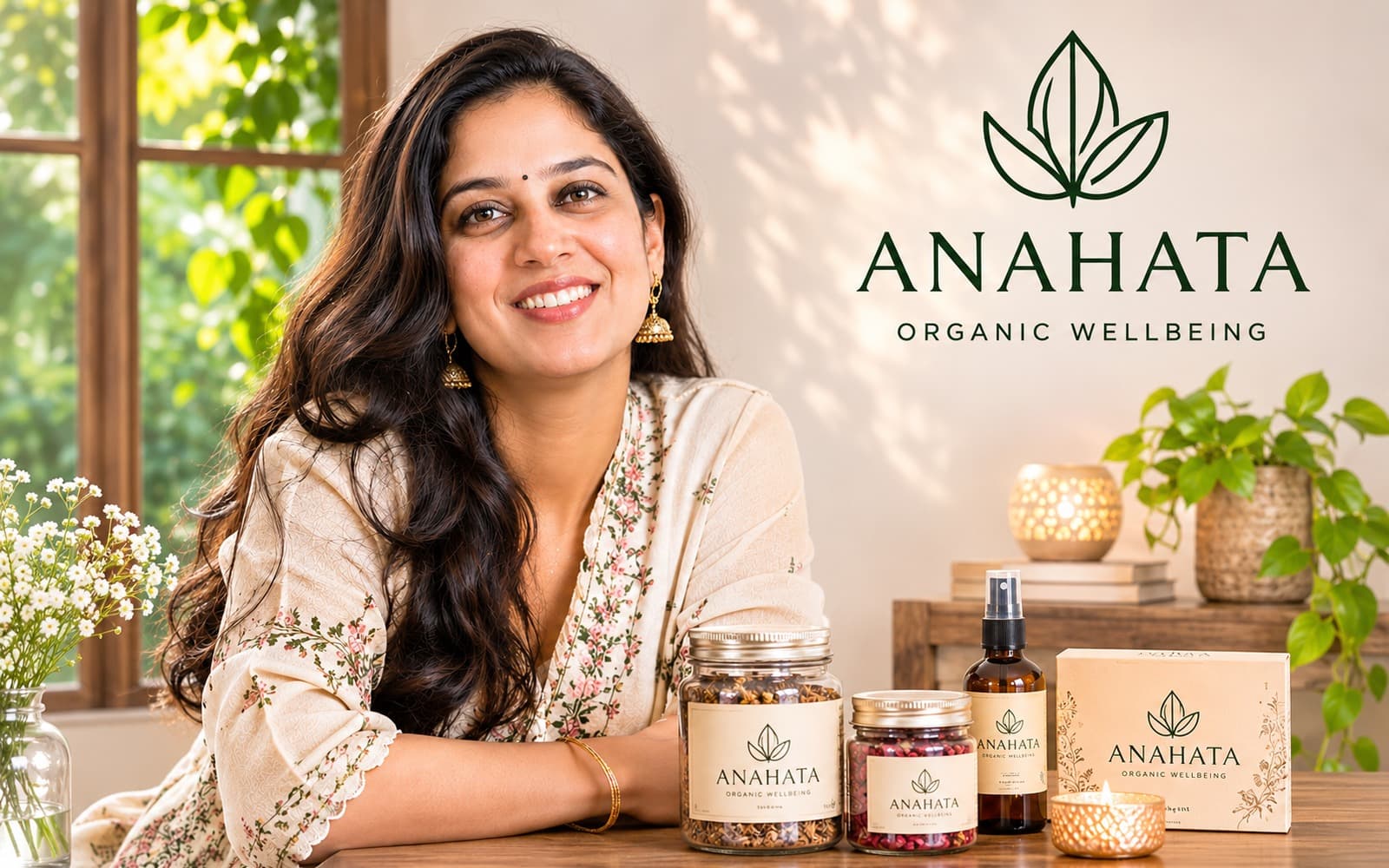
After two cancer diagnoses and a life-changing period in the Himalayas, Radhika Iyer Talati developed a deeper interest in yoga, naturopathy and traditional Indian wellness practices. She eventually turned that personal exploration into Anahata Organic, a business built around handcrafted products, local sourcing and a more conscious approach to everyday living.
In this story16 sections
- 1.Introduction: When a personal journey becomes a business vision
- 2.1. Radhika Iyer Talati: An entrepreneur before Anahata
- 3.2. The health experience that changed her perspective
- 4.3. The Himalayas: Where traditional knowledge shaped the idea
- 5.4. Why she decided to start Anahata Organic
- 6.5. From an idea to a business: Building Anahata
- 7.6. Creating products with a connection to Indian traditions
- 8.7. A business model built around farmers and local communities
- 9.8. Sustainability as a business decision
- 10.9. From online sales to a wider retail presence
- 11.10. Raa Foundation: The community mission behind the business
- 12.11. The challenges of building an organic wellness company
- 13.12. Anahata's evolution and its next chapter
- 14.13. What makes Anahata's business approach distinctive?
- 15.14. Lessons entrepreneurs can learn from Radhika Iyer Talati
- 16.Conclusion: From a search for balance to a business rooted in wellness
Introduction: When a personal journey becomes a business vision
For many entrepreneurs, a business begins with a market opportunity. For Radhika Iyer Talati, the inspiration for Anahata Organic came from a much more personal place.
After facing cancer twice, Talati began reassessing her relationship with health, lifestyle and the environment. Her search for a more holistic way of living took her to the Himalayas, where she spent time learning about yoga, naturopathy, traditional ingredients and nature-based practices.
The experience changed how she thought about everyday wellness. She became interested in the knowledge behind traditional recipes, the ingredients used in Indian households and the connection between individual well-being and the natural world.
Years later, this interest developed into Anahata Organic, a Vadodara-based business offering natural and handcrafted products across beauty, food and lifestyle categories.
But Anahata's story is not simply about launching another organic product label. It is about an entrepreneur attempting to translate personal learning, traditional knowledge and community values into a commercial business.
1. Radhika Iyer Talati: An entrepreneur before Anahata
Radhika Iyer Talati's entrepreneurial journey began well before she entered the wellness industry.
According to Raa Foundation's founder profile, she started her first business in event management in 2001. She later established a yoga-focused initiative that developed into Raa Foundation, a community platform centred on yoga, mindful living and service.
Her interests were not limited to business. Talati is also known for her involvement in yoga, mountaineering and outdoor adventure. Her experiences travelling through the Himalayas became an important influence on her personal philosophy and, eventually, on the products she wanted to bring to market.
This background gave her a combination of entrepreneurial experience and a sustained interest in wellness. By the time she began developing Anahata, she was not approaching the market as a first-time business owner. She had already spent years building organisations, working with communities and exploring the relationship between traditional Indian practices and contemporary lifestyles.
2. The health experience that changed her perspective
Talati's personal health journey became a defining chapter in her life.
In interviews with YourStory, she discussed being diagnosed with uterine cancer in the early 2000s and later facing breast cancer. The second diagnosis prompted her to reconsider her lifestyle and explore different approaches to well-being.
Her search led her to the Himalayas, where she spent several months learning about yoga, Ayurveda and naturopathy. She became more attentive to food, physical activity, meditation and the importance of mental and emotional well-being.
It is important to distinguish her personal experience from medical advice. Talati has acknowledged in her interviews that her experience should not be interpreted as a recommendation to replace conventional cancer treatment with alternative therapies. Her own circumstances involved medical care and the stage at which her illness was detected.
What emerged from the experience was a lasting interest in holistic living—not a claim that natural products can cure serious diseases.
For Talati, wellness became a broader daily practice involving how people eat, move, care for their bodies and connect with their surroundings.
3. The Himalayas: Where traditional knowledge shaped the idea
The Himalayas played a significant role in shaping Talati's understanding of wellness.
During her time in the mountains, she encountered people with different backgrounds, including local communities, yoga practitioners, travellers and traditional knowledge holders. Through these interactions, she learned about natural ingredients, household preparations, oils, herbs and everyday rituals.
Some of the recipes that later influenced Anahata were drawn from traditional practices and handwritten family collections. Rather than treating wellness as a collection of fashionable products, Talati became interested in how simple ingredients and familiar routines could be incorporated into daily life.
This period also strengthened her connection with nature and sustainable living. She developed an appreciation for local sourcing, traditional food practices and the people who preserve regional knowledge.
The experience gave her a broad foundation for the brand she would eventually create: one that connected Indian wellness traditions with products that modern consumers could use in their everyday routines.
4. Why she decided to start Anahata Organic
The idea behind Anahata developed over several years. Talati had been experimenting with natural recipes and preparations for personal use and sharing them with family and friends.
The COVID-19 pandemic strengthened her decision to turn this interest into a formal business. In a 2021 interview with YourStory, she explained that she saw a gap between the growing interest in organic living and the availability of products she considered genuinely connected to Indian ingredients, traditions and consumer needs.
She wanted to create a brand that offered more than a few natural skincare products. Her vision included food, personal care and everyday wellness products, supported by a supply chain that could involve small farmers, local manufacturers and women-led workforces.
The brand name also reflected its philosophy. Anahata refers to the heart chakra in Indian spiritual traditions and is associated with balance, compassion and serenity.
The name was intended to communicate the values behind the business: conscious living, simplicity, connection and care for nature.
5. From an idea to a business: Building Anahata
Anahata's development involved a gradual transition from personal experimentation to commercial manufacturing.
The brand's official timeline records the incorporation of the company in July 2020 and the opening of its first manufacturing facility in Vadodara during the same month. Product testing and sampling followed, allowing the team to gather feedback before launching online.
The website went live in January 2021, marking the start of its direct-to-consumer business across India.
This distinction is worth noting: some media profiles describe Anahata as founded in 2019, reflecting the earlier development of the business idea, while the company's own milestone timeline records incorporation in July 2020 and its online launch in January 2021.
Rather than entering the market with a single hero product, Anahata developed a wider range of offerings across skincare, beauty, food and traditional wellness categories.
Its early product portfolio included items such as:
-
Nabhira navel oil
-
Kumkumadi Thailam
-
Aloe vera gel
-
Rose cream and rose water
-
Natural oils and blends
-
Food staples, salts and flours
The range reflected the founder's intention to bring traditional recipes and natural ingredients into everyday routines.
6. Creating products with a connection to Indian traditions
One of Anahata's defining characteristics is its emphasis on traditional Indian ingredients and preparations.
The brand describes its formulations as inspired by Ayurveda, naturopathy and Himalayan recipes. Its philosophy centres on using familiar ingredients and handcrafted processes rather than relying solely on trends in the global beauty and wellness market.
A notable example is Nabhira, its navel oil product. The company says it became one of its best-selling products and was nominated for the Vogue Beauty Festival Awards in 2021.
Another product that helped the brand gain visibility was its Sambrani Dhoop. In June 2021, Anahata published a video about the product that the company says crossed one million views on Instagram. This helped introduce the brand to a larger social media audience.
These products illustrate how Anahata combined traditional practices with modern digital marketing. Instead of presenting its offerings only as packaged consumer goods, the company used storytelling to explain their cultural context and the rituals associated with them.
Editorial note: Traditional use and brand positioning should not be confused with clinically established health benefits. Claims about gut health, hormonal conditions or disease treatment should be supported by appropriate scientific evidence before publication.
7. A business model built around farmers and local communities
Anahata's business philosophy extends beyond product formulation.
From its early stages, the company described its manufacturing and sourcing approach as a way to support small farmers, women entrepreneurs and local businesses.
In a 2021 YourStory profile, Talati said that around 70% of the production workforce consisted of local women from villages around Vadodara and other parts of Gujarat. The same report described a team of approximately 24 people at that time.
The company also reported buying from organic farmers during the pandemic, when many small producers were facing difficulties securing reliable demand.
Anahata's official timeline records the integration of more than 35 farmers into its supply chain in 2022 and 55 farmers by January 2023.
This approach gave the company a wider purpose than simply selling natural products. It sought to create economic opportunities for people involved in sourcing, manufacturing and packaging.
The model also presented practical challenges. Working with small suppliers and local producers requires coordination, quality control and consistency—especially when a business is trying to grow its product range and serve customers across different markets.
8. Sustainability as a business decision
For Anahata, sustainability was positioned as part of the product and operational strategy rather than simply a marketing message.
Talati spoke about choosing glass, tin and recycled materials instead of conventional plastic packaging, even when the alternatives increased costs.
This was a commercial decision with real trade-offs. Glass and metal packaging can increase product weight, transport costs and handling requirements. For a young consumer brand, these expenses can affect pricing and margins.
The company nevertheless made plastic reduction an explicit objective.
According to Anahata's official timeline, it achieved plastic-free packaging for its beauty products in April 2023. The brand also describes its wider values in terms of pesticide-free farming, ethical manufacturing and responsible sourcing.
The sustainability approach is an important part of its positioning, although individual product and packaging claims should be checked against the company's current specifications before being presented as applying to every item in its catalogue.
9. From online sales to a wider retail presence
Anahata initially focused on selling directly to customers through its own website.
As the brand developed, it began exploring partnerships with specialist retail and e-commerce platforms whose customers were already interested in natural products and sustainable consumption.
A 2021 YourStory report mentioned platforms such as Brown Living and Vanity Wagon for beauty and skincare products, alongside other niche marketplaces.
In May 2022, the company opened its first flagship store, Anahata Bazaar, in Vadodara. This created a physical space where customers could discover the products and engage with the brand beyond an online shopping experience.
The company later expanded its digital ambitions. Its official timeline records that in January 2024, it opened its website and products to customers in the United States and the United Arab Emirates.
This international step reflected the possibility of taking Indian wellness-inspired products to consumers outside India, while retaining the brand's connection to traditional recipes and ingredients.
10. Raa Foundation: The community mission behind the business
Anahata is connected to a wider wellness initiative that Talati had established before launching the brand: Raa Foundation.
The foundation grew out of her earlier work in yoga and mindful living. Its stated purpose is to help people bring yogic principles into everyday life through community activities, learning and service.
The connection between the two organisations is significant. Anahata focuses on products and commerce, while Raa Foundation provides a platform for education, community engagement and wellness-related initiatives.
The company's official story also identifies the Raa Foundation as an organisation it supports. In 2023, Anahata records that it conceptualised, built and donated a landmark sculpture to Vadodara called Raa Foundation Circle, representing the importance of yoga and meditation.
This relationship helps explain why Anahata presents itself as more than a conventional organic product company. Its founder's wider work in yoga, community building and traditional knowledge is part of the identity she has developed for the brand.
11. The challenges of building an organic wellness company
Anahata's journey also highlights the difficulties of creating a business around natural products and conscious consumption.
In her 2021 interview with YourStory, Talati identified several challenges that the company faced in its early stages.
Educating customers: Consumers may express interest in organic living but still choose familiar, convenient or lower-priced alternatives. Convincing customers to understand the value of ingredients, sourcing and production requires sustained communication.
Building a reliable supply chain: Working with small farmers and local producers can support communities, but it also requires dependable sourcing, quality checks and consistent supply.
Managing manufacturing costs: Handcrafted processes and alternatives to plastic packaging can cost more than mass-produced options. Maintaining a price that customers will accept while protecting product quality is a continuing business challenge.
Creating a customer base: A new brand must earn trust in a market where established companies already have distribution, advertising budgets and customer recognition.
Building the right team: Talati has spoken about the difficulty of finding people who understand and share the company's longer-term values, particularly when it chooses people-intensive processes over extensive mechanisation.
These challenges illustrate a wider truth about purpose-led consumer businesses: a strong mission may help attract customers and employees, but it must be supported by efficient operations and a commercially sustainable model.
12. Anahata's evolution and its next chapter
Anahata has continued to develop its identity from an Indian natural products business into a broader wellness and lifestyle brand.
Its official milestones show several important developments:
-
2020: Company incorporation and establishment of the first manufacturing facility in Vadodara.
-
2021: Direct-to-consumer website launch, early product recognition and growth of its social media community.
-
2022: Integration of more farmers, opening of Anahata Bazaar in Vadodara and wider media recognition.
-
2023: Achievement of plastic-free packaging for its beauty products and a rebranding initiative for international markets.
-
2024: Expansion of website sales availability to the United States and the United Arab Emirates.
The company's current website describes a catalogue spanning more than 300 products and presents Anahata as an Indic wellness brand covering beauty, food, worship essentials, oils and blends.
Its stated ambition is to build a global community around Indian wellness traditions, sustainable living and access to natural products.
The opportunity ahead is to balance that broad vision with the discipline required to grow a diverse product portfolio: consistent quality, credible product information, reliable sourcing and a customer experience that can work across markets.
13. What makes Anahata's business approach distinctive?
Anahata's story brings together several elements that help explain its positioning in India's growing natural wellness market.
A founder-led purpose: The business emerged from Talati's personal interest in holistic living, traditional knowledge and nature-based practices.
A broad wellness proposition: Instead of concentrating on one category, the brand connects skincare, beauty, food and lifestyle products.
Traditional knowledge with contemporary access: The company presents traditional recipes and ingredients through modern product formats and online retail.
Local sourcing and employment: Its reported work with farmers and women in production connects the business to communities around Vadodara and beyond.
Sustainability in operations: Its packaging choices show an attempt to make environmental considerations part of the business model, even when they involve higher costs.
Community beyond commerce: The relationship with Raa Foundation gives the founder's work a wider platform for yoga, learning and community engagement.
The combination is central to Anahata's identity. Its proposition is not only that customers should buy natural products, but that everyday consumption can be connected to a wider philosophy of mindful and responsible living.
14. Lessons entrepreneurs can learn from Radhika Iyer Talati
Radhika Iyer Talati's journey offers practical lessons for founders building businesses around personal experience, traditional knowledge and consumer values.
1. Personal experience can reveal a market gap.
Talati's interest in holistic living gave her a starting point for identifying products and practices she believed were missing from the market. Personal experience can be a powerful source of business insight when it is translated into a genuine customer need.
2. Build credibility before expanding the product range.
An organic or wellness brand needs to communicate clearly about its ingredients, sourcing, manufacturing and product claims. Trust is essential in a category where consumers are increasingly careful about what they put on their skin and into their bodies.
3. Make the supply chain part of the business strategy.
Working with small farmers and local producers can create economic opportunities while helping a brand build a distinctive sourcing story. It also requires consistent standards and strong operational relationships.
4. Sustainability requires commercial commitment.
Choosing alternative packaging or people-intensive production may increase costs. A founder needs to understand those trade-offs and build a business model that can support them.
5. Build a community around a shared purpose.
Anahata's connection with Raa Foundation reflects the value of building relationships that extend beyond transactions. Community engagement can create deeper connections with customers and local stakeholders.
6. Grow without losing the original philosophy.
Expanding into new markets and product categories creates opportunities, but it also makes it important to maintain consistent quality and a clear brand identity.
Conclusion: From a search for balance to a business rooted in wellness
Radhika Iyer Talati's journey is a story of personal reinvention, entrepreneurial experience and a sustained interest in India's traditional wellness practices.
Her health experiences prompted her to reconsider how she approached everyday living. Time in the Himalayas deepened her interest in yoga, naturopathy and natural ingredients. Years of experimentation and community involvement eventually led to Anahata Organic.
What began as a personal search for a more holistic lifestyle developed into a business that brings together skincare, food, traditional preparations and sustainable living. Through its sourcing and employment approach, the company has also sought to create opportunities for farmers, local producers and women in its workforce.
Anahata's journey demonstrates that a founder's personal philosophy can become the foundation of a consumer brand—but lasting growth depends on much more than an inspiring origin story. It requires product quality, customer education, operational discipline and the ability to build trust over time.
For aspiring entrepreneurs, Talati's story offers a reminder that a business can begin with a personal question: What kind of life do I want to live? The entrepreneurial challenge is turning the answer into something useful, credible and valuable for others.
More Health & Wellness stories

Khushboo Aggarwal – Zyla: How a Family Healthcare Experience Inspired an Indian Health-Tech Startup
When her father experienced a cardiac emergency linked to diabetes, Khushboo Aggarwal confronted a problem that many Indian families understand: healthcare does not end when a patient leaves the hospital. Inspired by that experience, she founded Zyla Health in 2017 to make personalised, continuous healthcare support more accessible through technology.
Read story
Smita Satiani – Alaya Tea: How an Indian-American Entrepreneur Is Bringing India's Tea Heritage to the Modern American Market
Smita Satiani, Alaya Tea, Indian-American entrepreneurs, Indian tea brands in USA, sustainable tea business, women entrepreneurs, regenerative agriculture, Indian-origin founders.
Read story
Elixir Wellness: How Tanya Khubchandani Vatsa Is Bringing Preventive Healthcare and Medical Wellness to India
Educated in the United States and shaped by experience inside major New York healthcare institutions, Tanya Khubchandani Vatsa returned to India with a different perspective on healthcare. Her venture, Elixir Wellness, is built around a growing idea: wellbeing should not begin only when someone falls ill.
Read story