
Sachin and Babi Ahluwalia: From India to New York – Building an International Fashion Label
How an Indian designer couple transformed their knowledge of embroidery and textiles into a globally recognised fashion business, bringing the artistry of Indian craftsmanship to the international luxury industry.
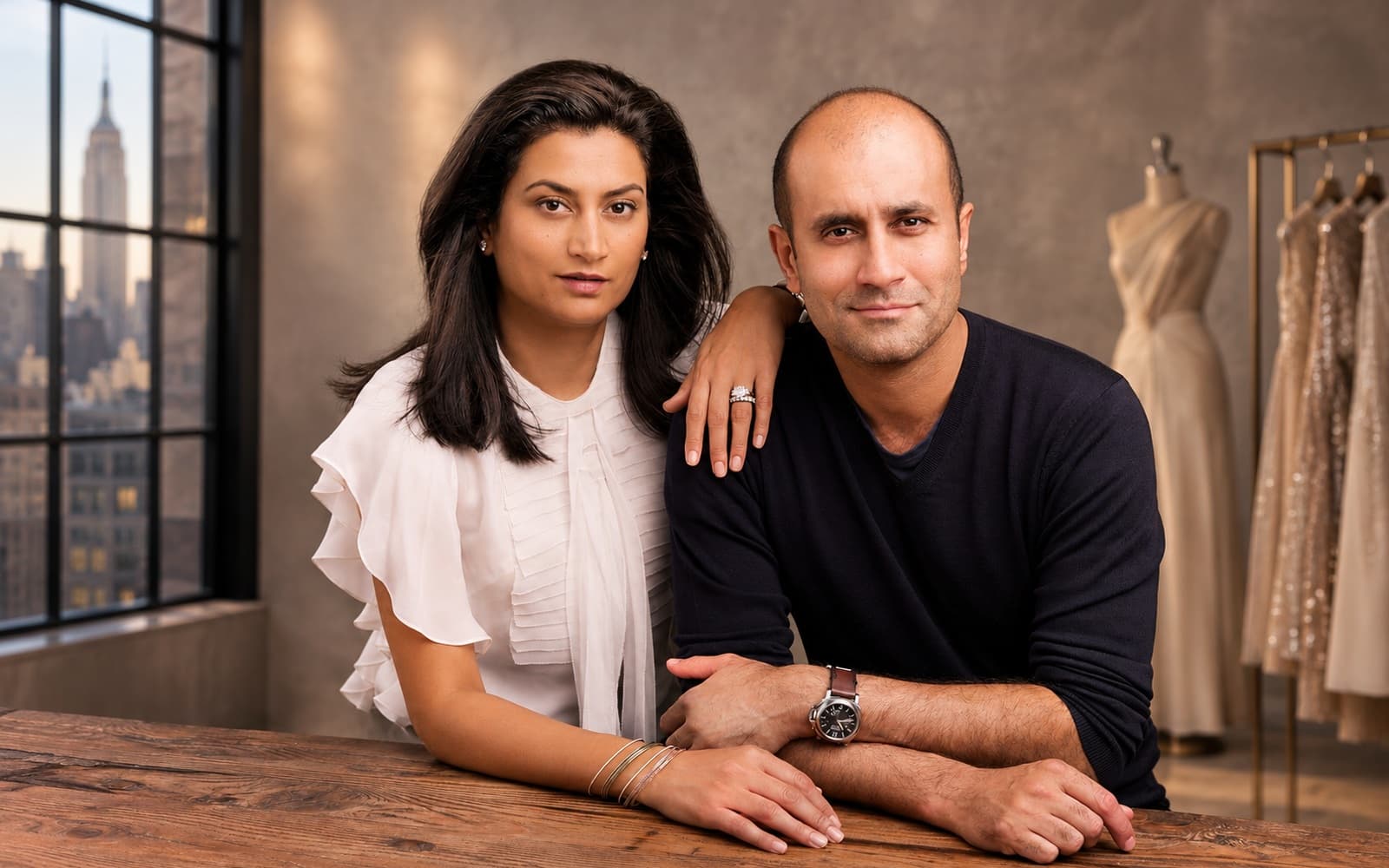
In this story14 sections
- 1.1. Two Designers from India, One Shared Dream
- 2.2. Before Their Own Label, They Built an Embroidery Business
- 3.3. The Decision to Launch Sachin & Babi in 2009
- 4.4. Bringing Indian Embroidery into the International Fashion Conversation
- 5.5. The Mumbai Connection: Keeping Craftsmanship Close to Home
- 6.6. Recognition from the American Fashion Industry
- 7.7. Expanding Beyond Ready-to-Wear
- 8.8. The Philosophy Behind Sachin & Babi: Luxury That Women Can Wear
- 9.9. Navigating the Pandemic and Changing the Fashion Business
- 10.10. A New Generation of Accessories and Bridal Experiences
- 11.11. The Business Beyond the Brand: A Partnership in Life and Design
- 12.12. Evolving the Customer Experience: From Retail to Personal Service
- 13.13. What Entrepreneurs Can Learn from Sachin and Babi's Journey
- 14.From India to New York: A Legacy Stitched into Every Detail
Some fashion labels are built around a designer's individual vision. Others emerge from a partnership in which two people combine their talents, experiences and cultural identities to create something neither could have built alone.
Sachin and Babi Ahluwalia, the husband-and-wife team behind Sachin & Babi, belong to the second category.
Originally from India, the couple moved to New York to study fashion and eventually established a business that connected Indian embroidery expertise with the demands of international luxury fashion houses. Before their own label became known for sophisticated occasionwear, they were working behind the scenes, developing intricate textiles and embroidery for some of the world's most respected designers.
Their journey is particularly significant because they did not begin by trying to build a conventional fashion brand. They first built expertise in craftsmanship, developed relationships with luxury fashion houses and learned how the international fashion industry operated.
In 2009, they launched their own label, Sachin & Babi, bringing those years of experience directly to women who wanted distinctive, beautifully crafted clothing.
Today, their business represents a compelling example of how Indian craftsmanship can become an important part of international luxury fashion without losing its cultural identity.
This is the story of how two designers from India turned their shared passion for textiles into a New York fashion house.
1. Two Designers from India, One Shared Dream
Sachin and Babi Ahluwalia both grew up in India, where textiles, colour and craftsmanship were part of their cultural environment.
Their families also had connections to the apparel and design industry. In a 2024 interview with the Council of Fashion Designers of America (CFDA), the couple explained that both their mothers were designers in India's domestic apparel trade.
This early exposure gave them an appreciation for fabrics, construction and the creative possibilities of clothing.
However, their professional journey took shape in a different country.
In 1994, both arrived in New York to pursue fashion education at the Fashion Institute of Technology (FIT). They met during their first semester and quickly discovered shared interests, ambitions and cultural backgrounds.
Sachin was interested in the technical and construction aspects of fashion, while Babi brought an understanding of textiles, colour and the way women relate to clothing.
Their friendship developed into a relationship, and in 1996, they married in New Delhi.
What began as a meeting between two Indian students in New York would eventually become a long-running creative and business partnership.
2. Before Their Own Label, They Built an Embroidery Business
The early years of Sachin and Babi's entrepreneurial journey were spent developing a business that operated largely behind the scenes.
After graduating from FIT, the couple established ANK International, an embroidery and design service that connected Indian textile craftsmanship with fashion designers in New York, Milan and Paris.
Their business developed custom embroidery, surface textures, embellishments and textile details for established fashion houses.
This was a strategic starting point.
Instead of immediately launching a collection and competing for retail customers, they focused on a specialised area where their knowledge of Indian craftsmanship could offer a clear advantage.
The couple developed relationships with international designers and built a network of skilled artisans and craftsmen in India.
Their work eventually reached some of the most respected names in luxury fashion, including:
-
Oscar de la Renta
-
Carolina Herrera
-
Jean Paul Gaultier
-
Manolo Blahnik
Their embroidery and textile work also connected them with other prominent international designers and labels.
For nearly two decades, they developed their understanding of luxury fashion through this specialised business. They learned what international designers expected from materials, craftsmanship, finishing and production.
This experience would become one of their biggest competitive advantages when they eventually decided to create their own label.
3. The Decision to Launch Sachin & Babi in 2009
After years of developing textiles and embroidery for other designers, the couple began thinking about creating something of their own.
They had spent years contributing to other fashion houses' creative visions. Now they wanted to connect directly with the women who would wear their designs.
In 2009, Sachin and Babi launched their eponymous fashion label, Sachin & Babi.
Their objective was to take the elaborate craftsmanship, detailed embroidery and sophisticated design sensibility they had developed through their earlier work and translate them into a contemporary women's fashion collection.
The brand was positioned around elevated, sophisticated and accessible design.
This was an important distinction.
Luxury fashion often places significant emphasis on exclusivity and high prices. Sachin and Babi wanted to make exceptional craftsmanship more accessible through ready-to-wear clothing that women could actually wear and enjoy.
Their collections combined statement details with practical silhouettes, allowing customers to dress for weddings, celebrations, evening events and other important occasions.
The launch marked the transition from being specialist suppliers to becoming designers with a direct relationship with their customers.
4. Bringing Indian Embroidery into the International Fashion Conversation
One of the defining characteristics of Sachin & Babi is its connection to Indian embroidery.
India has a long history of textile artistry, with different regions known for distinctive weaving, stitching, embellishment and decorative techniques.
For Sachin and Babi, these traditions were not simply design references. They were part of their professional heritage and the foundation of their business.
Their collections are recognised for:
-
Intricate hand embroidery and threadwork.
-
Rich colours and decorative embellishments.
-
Textured fabrics and distinctive surface treatments.
-
Sophisticated silhouettes.
-
Contemporary interpretations of traditional craftsmanship.
In a 2024 CFDA interview, the designers explained that colour was deeply connected to their upbringing in India. They described how the vibrancy of Indian culture naturally influenced their use of colour in their Western collections.
They also emphasised that craftsmanship remained central to their identity as dressmakers.
This philosophy helped the brand establish a distinctive position: Indian craftsmanship presented through modern American fashion design.
Rather than reproducing traditional Indian garments, the couple translated the techniques and artistic sensibilities of India into contemporary dresses, gowns, separates and occasionwear.
The result was a fashion identity that was international in its presentation but Indian in many of its creative foundations.
5. The Mumbai Connection: Keeping Craftsmanship Close to Home
One of the most important decisions in the development of Sachin & Babi was maintaining a direct connection with production in India.
The couple established and retained a family-run manufacturing operation in South Mumbai. This allowed them to oversee the creative and production processes more closely, from initial sampling to finished garments.
Their manufacturing model was built around a relationship that extended beyond a conventional supplier arrangement.
In the 2024 CFDA interview, Sachin and Babi explained that their family business had roots in an earlier generation. Babi's mother had established a business in the 1980s, and the couple continued to use the infrastructure she had developed.
They also described their artisans as second-generation craftspeople, reflecting relationships and skills that had been built over many years.
This connection is central to understanding the brand.
The couple's New York operation brings together design direction, international customers and fashion business development. Their Mumbai production base provides access to skilled embroidery and textile craftsmanship.
The arrangement allows the designers to combine two very different strengths:
-
New York's international fashion environment and contemporary design perspective.
-
India's established textile traditions and highly skilled artisan workforce.
The official brand describes its factory ownership as a way to maintain control over design and production while reducing unnecessary intermediaries.
For customers, this means the embroidery and construction are not simply decorative additions. They are integral to the identity of each garment.
6. Recognition from the American Fashion Industry
Building a fashion label in New York is challenging, particularly for designers entering an industry with established luxury houses, retailers and influential fashion institutions.
Sachin and Babi's earlier work with international designers helped them understand the expectations of the industry. Their own label gradually built recognition through its design identity, collections and retail relationships.
A significant milestone came in 2013, when the couple became members of the Council of Fashion Designers of America (CFDA).
The CFDA is one of the important professional organisations representing American fashion designers. Membership placed Sachin and Babi within a wider community of established and emerging American fashion talent.
Their story also stood out because they were immigrants who had built their professional lives in the United States while retaining strong connections to India.
In a 2017 CFDA interview, they spoke about the importance of inclusion and the contribution of international talent to the American fashion industry.
For the couple, their background was not something to separate from their American business identity. It was an important part of what made their work distinctive.
7. Expanding Beyond Ready-to-Wear
As Sachin & Babi developed, the couple began extending the brand into additional fashion categories.
The company's official timeline records several important developments:
|
Year |
Milestone |
|---|---|
|
2009 |
First ready-to-wear collection launched |
|
2011 |
Madison Avenue flagship store opened |
|
2013 |
Joined the CFDA |
|
2015 |
Introduced fashion jewellery |
|
2016 |
Presented first bridal collection |
|
2017 |
Introduced Ahluwalia, a label developed exclusively for Saks Fifth Avenue |
The expansion into bridalwear was particularly relevant to the brand's identity.
Wedding fashion and special occasions require an understanding of more than seasonal trends. Customers look for distinctive design, flattering silhouettes, beautiful fabrics and craftsmanship that makes an outfit memorable.
Sachin and Babi's experience with embroidery and detailed surface work gave them a natural foundation in this segment.
Their bridal offering also evolved. In 2022, the couple introduced the Ready To Celebrate (RTC) concept, designed to serve not only brides but also members of the wedding party and guests.
The idea reflected their belief that special-occasion fashion should be versatile and wearable, rather than limited to a single moment.
8. The Philosophy Behind Sachin & Babi: Luxury That Women Can Wear
The brand's philosophy has always centred on the woman wearing the garment.
Sachin and Babi have repeatedly emphasised that their designs should make women feel confident, comfortable and ready to participate in the moments they are dressing for.
This perspective is reflected in the brand's approach to occasionwear.
Rather than creating clothing that looks impressive only in photographs or on a runway, the designers aim to balance decorative detail with wearability.
Their collections bring together:
-
Elegant evening dresses.
-
Cocktail and party dresses.
-
Wedding guest outfits.
-
Bridal and celebration gowns.
-
Statement separates and accessories.
-
Embellished designs for formal occasions.
The brand's design identity is recognisable through its use of embroidery, texture, colour and carefully considered silhouettes.
Its positioning also challenges the assumption that luxury fashion must always be formal or inaccessible.
For Sachin and Babi, a beautifully made dress should be something a woman enjoys wearing, not simply something she owns.
Their philosophy can be summed up in one idea: craftsmanship matters most when it becomes part of a woman's real life.
9. Navigating the Pandemic and Changing the Fashion Business
The COVID-19 pandemic created an enormous challenge for fashion brands, particularly those focused on weddings, eveningwear and special occasions.
Events were postponed, gatherings became smaller and customers had fewer reasons to purchase formal clothing.
For a business built around celebration dressing, this required a change in strategy.
By 2020, Sachin & Babi had already begun making several adjustments to its business model. In its Resort 2021 review, Vogue reported that the designers had launched e-commerce, lowered prices, invested in sustainable fabrics and reduced their collections to more essential pieces.
These changes helped the company respond to customers whose lifestyles and shopping habits were changing.
Instead of relying entirely on large events and traditional luxury retail, the designers focused on creating clothing for smaller gatherings and everyday occasions as well.
The experience reinforced the importance of adaptability.
The pandemic demonstrated that even a well-established fashion label cannot depend indefinitely on one category, one sales channel or one type of customer occasion.
For Sachin and Babi, it became an opportunity to reconsider how they connected with customers and how their collections could remain relevant during changing circumstances.
10. A New Generation of Accessories and Bridal Experiences
Sachin & Babi has continued to develop its product offering beyond its original womenswear collections.
In 2024, the couple told the CFDA that they had launched their first shoe and bag line earlier that year and were pleased with the response from customers.
They also discussed expanding their bridal capsules, including little white dresses and gowns for wedding guests.
This expansion is consistent with the brand's wider approach to occasion dressing.
A customer may first discover the label through an evening dress, then return for a wedding outfit, accessories or a different celebration.
Building a broader collection gives the company more opportunities to serve the same customer across different moments in her life.
The designers' approach is not simply about adding categories. It is about building a cohesive wardrobe around a recognisable design language.
11. The Business Beyond the Brand: A Partnership in Life and Design
One of the most interesting aspects of Sachin & Babi is that the business has been built around a personal partnership.
The couple met in 1994, married in 1996 and have worked together for decades.
Their different strengths have helped create a complementary design relationship.
Sachin has often approached fashion through construction, engineering and technical innovation. Babi has brought a strong understanding of textiles, colour, silhouette and the emotional relationship women have with clothing.
These different perspectives have influenced the way the brand develops its collections.
Their partnership also extends into family life. They have raised two daughters in Manhattan while building their businesses together.
In their 2025–2026 brand storytelling, the company continues to describe this partnership as central to its identity.
The couple's journey offers a useful lesson for entrepreneurs: a strong business partnership does not require identical skills. It requires shared values, complementary abilities and the willingness to build something together over time.
12. Evolving the Customer Experience: From Retail to Personal Service
The luxury fashion industry has changed considerably since Sachin and Babi launched their label.
Customers increasingly expect more than attractive products. They want personal attention, styling advice, alterations, convenient shopping and a relationship with the brands they purchase from.
In March 2026, Forbes reported on how Sachin & Babi had evolved its approach to customer relationships, moving towards a more personalised, concierge-style business model.
The designers had previously operated a Madison Avenue flagship boutique, which they described as an important way to understand customers and how they experienced the clothing. The pandemic brought that retail chapter to an end in 2020.
The subsequent shift towards more personalised customer engagement reflects a broader change in luxury retail: the experience surrounding a garment can be just as important as the garment itself.
For a brand specialising in occasionwear, personal styling and customer relationships can be particularly valuable. Women shopping for weddings, formal celebrations and special events often need guidance on silhouettes, sizing, alterations and complete looks.
The brand's evolution demonstrates that building a luxury fashion business is not only about developing beautiful collections. It is also about continually improving how customers discover, purchase and experience those designs.
13. What Entrepreneurs Can Learn from Sachin and Babi's Journey
The story of Sachin and Babi Ahluwalia offers several valuable lessons for designers and entrepreneurs hoping to build international fashion businesses.
1. Build expertise before building a brand.
The couple spent years developing embroidery and textile expertise before launching their own label. Their technical knowledge and industry relationships became a strong foundation for their fashion business.
2. Turn cultural heritage into a competitive advantage.
Instead of distancing themselves from their Indian background, they made Indian craftsmanship central to their design identity. Their use of colour, embroidery and textiles helped distinguish their collections in the international market.
3. Build relationships with the people who make your products.
Their long-standing connection with artisans and their family-run manufacturing operation in Mumbai demonstrate the importance of production relationships in a craftsmanship-led business.
4. Understand the customer, not just the industry.
Moving from supplying luxury fashion houses to creating their own ready-to-wear label required them to understand the women who would actually purchase and wear their designs.
5. Combine complementary strengths.
Their partnership brings together technical construction, textile knowledge, design and business development. Different perspectives can strengthen a business when they work towards a shared vision.
6. Adapt when the market changes.
Their response to the pandemic, investment in e-commerce and later development of a more personalised customer experience show why adaptability matters in luxury fashion.
7. Think beyond the first product category.
Expanding into bridalwear, jewellery, shoes and bags has allowed the brand to develop a broader relationship with its customers.
From India to New York: A Legacy Stitched into Every Detail
Sachin and Babi Ahluwalia's journey is a story of two Indian designers who understood the value of their heritage and found a way to bring it into the international fashion industry.
They arrived in New York as students in 1994, built an embroidery business after graduation and spent years working behind the scenes for some of the world's most respected fashion houses.
When they launched Sachin & Babi in 2009, they were not starting from scratch. They were bringing years of experience, relationships and technical expertise into a brand of their own.
Their connection to Mumbai's artisans and textile traditions remained central even as the business grew internationally.
From ready-to-wear collections and bridal fashion to accessories and personalised customer experiences, the brand has continued to evolve while maintaining its distinctive emphasis on craftsmanship, colour and embellishment.
Perhaps the most important part of their story is that they did not treat Indian craftsmanship as something that belonged only to traditional ethnic clothing.
They demonstrated that Indian embroidery could be part of contemporary American fashion, international occasionwear and luxury ready-to-wear.
Their journey proves that heritage does not have to remain in the past. With creativity, business vision and respect for craftsmanship, it can become the foundation of a global fashion identity.
More Fashion & Apparel stories
Kashesh Bhatia Garg: From Ahmedabad to Dubai – Building a Luxury Fashion House with a Global Vision
How an Indian fashion entrepreneur transformed her creative beginnings in Ahmedabad into Kashesh Global, a Dubai-based conscious luxury fashion house blending heritage, craftsmanship, sustainability and contemporary design.
Read story
Nimita Sanwal: From a Small Lingerie Wholesale Business to Building Snazzyway, India's Manufacturer-Led Dropshipping Ecosystem
How a woman entrepreneur transformed a small business idea into a fashion manufacturing company, built a network of thousands of resellers and created a technology platform to help entrepreneurs launch and scale online businesses.
Read story
Shreya Patel: From India to America – Building RAAS Through Indian Craftsmanship and Contemporary Fashion
How an immigrant entrepreneur turned a lifelong passion for fashion into a Chicago-based label, bringing Indian artistry to the American fashion market while building a business around ethical production and traditional craftsmanship.
Read story