
From a Consumer Problem to a Premium D2C Brand: How Aishwarya Iyer Built Brightland
Discover how Aishwarya Iyer transformed her passion for quality ingredients into Brightland, a premium olive oil brand combining California sourcing, transparent production, and distinctive packaging to redefine everyday kitchen essentials.
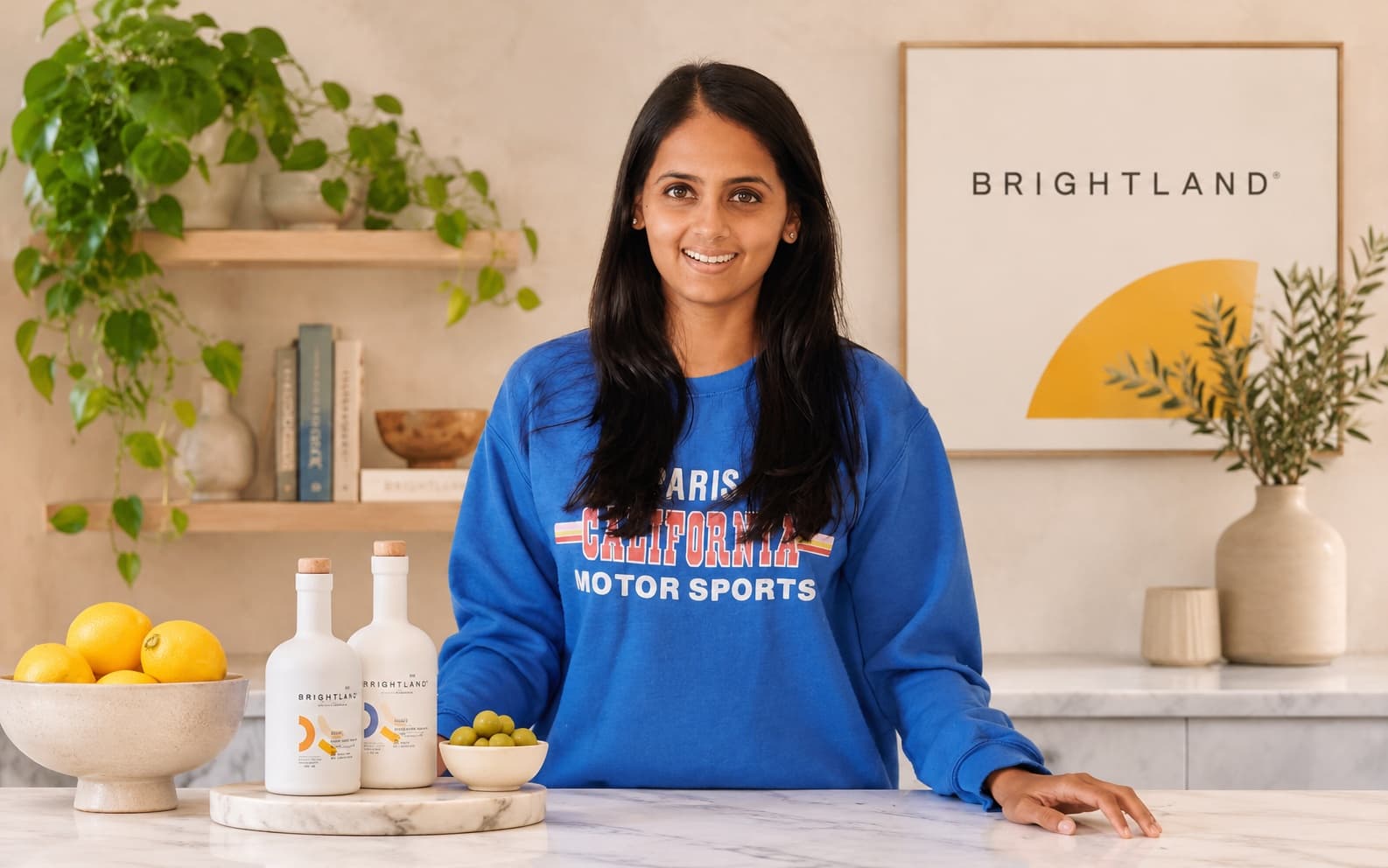
In this story20 sections
- 1.In This Story
- 2.1. Growing Up With a Connection to Food
- 3.2. From Communications to Entrepreneurship
- 4.3. Discovering an Opportunity in the Olive Oil Market
- 5.4. Learning the Business From the Ground Up
- 6.5. Launching Brightland in 2018
- 7.6. Turning Packaging Into a Brand Advantage
- 8.7. Building Trust Through Sourcing and Transparency
- 9.8. Expanding Beyond Olive Oil
- 10.9. Building a Premium Direct-to-Consumer Business
- 11.10. Business Lessons for Aspiring Entrepreneurs
- Lesson 1: Look for opportunities in familiar products
- Lesson 2: Research the product before building the marketing
- Lesson 3: Transfer skills from one industry to another
- Lesson 4: Make design support the value proposition
- Lesson 5: Build trust through verifiable information
- Lesson 6: Expand around a clear brand identity
- Lesson 7: Consider the role of gifting
- Lesson 8: Choose distribution channels strategically
- 12.11. The Takeaway: Making an Everyday Product Feel Different
Olive oil is one of those products that many people purchase without giving it much thought. It sits on kitchen shelves, appears in everyday recipes, and is often treated as a basic grocery item rather than a premium product.
For Aishwarya Iyer, however, a closer look at olive oil revealed an opportunity to build a different kind of business.
After spending years working in communications and technology, Iyer became increasingly interested in cooking at home and understanding the ingredients she used. Her research into olive oil quality raised questions about freshness, authenticity, and transparency in the industry.
Rather than accepting the limitations of the existing market, she began exploring whether there was room for a brand that approached olive oil differently.
Her answer was Brightland, a California-based food brand launched in 2018. The company set out to combine carefully sourced ingredients with attractive packaging, clear product storytelling, and a more considered approach to an everyday pantry essential.
Iyer did not come from a traditional agricultural or food-manufacturing background. She brought experience in communications, marketing, and brand positioning, then developed her knowledge of olive oil through research, classes, and visits to California farms.
That combination helped shape Brightland's identity. Its products were designed to appeal not only to people interested in food quality but also to consumers who appreciated design, thoughtful sourcing, and the experience of cooking.
The company began with olive oil and gradually expanded into other pantry products, including vinegars and honey. It also developed a premium positioning that made its products suitable for gifting as well as everyday use.
Brightland's journey illustrates how entrepreneurs can discover opportunities in established markets by questioning familiar assumptions, understanding a product more deeply, and building a brand around a clear point of view.
For aspiring founders, Iyer's story offers lessons in market research, product differentiation, packaging, customer trust, and the process of transforming a personal interest into a consumer business.
Sources: Brightland's official website and Forbes Vetted's profile of Aishwarya Iyer.
In This Story
-
Growing Up With a Connection to Food
-
From Communications to Entrepreneurship
-
Discovering an Opportunity in the Olive Oil Market
-
Learning the Business From the Ground Up
-
Launching Brightland in 2018
-
Turning Packaging Into a Brand Advantage
-
Building Trust Through Sourcing and Transparency
-
Expanding Beyond Olive Oil
-
Building a Premium Direct-to-Consumer Business
-
Business Lessons for Aspiring Entrepreneurs
-
The Takeaway
1. Growing Up With a Connection to Food
Aishwarya Iyer's entrepreneurial journey was shaped partly by her Indian-American upbringing and her family's relationship with food.
Growing up in an immigrant household, she experienced the importance of stability, education, and building a secure future. Her family valued conventional markers of success, while Iyer gradually developed an interest in exploring different professional and creative possibilities.
She attended New York University, where she studied at the Gallatin School of Individualized Study. Her academic interests included media, globalization, and South Asian gender studies.
Although her early career did not follow a path into food or agriculture, food remained an important part of her life.
Cooking became a way to explore ingredients, understand flavours, and develop a deeper appreciation for the relationship between what people eat and where it comes from.
Iyer has also spoken about discovering that her ancestors in Tamil Nadu, South India, were salt farmers. That connection helped strengthen her interest in the relationship between food, land, and traditional production.
These experiences did not automatically lead to a business idea. Instead, they contributed to a perspective that would become important when she began developing Brightland.
For Iyer, food was not simply about preparing meals. It was also about the ingredients behind them, the people producing those ingredients, and the experience of sharing something thoughtfully made.
That perspective eventually influenced Brightland's emphasis on sourcing, craftsmanship, and the emotional experience of cooking.
For entrepreneurs, this part of her story highlights how personal interests and cultural experiences can shape a business's values without needing to determine its entire business model from the beginning.
Source: Reviewed — Interview with Brightland founder Aishwarya Iyer.
2. From Communications to Entrepreneurship
Before launching Brightland, Iyer spent more than a decade working in communications and public affairs.
Her professional experience included working at L'Oréal's luxury products division, including Lancôme, as well as roles connected to technology companies and startups.
These experiences exposed her to how consumer brands communicate value, establish their identities, and connect with customers.
In established consumer categories, the product itself is only one part of the purchasing decision. Customers also respond to packaging, reputation, positioning, and the way a company explains what makes its offering different.
Beauty brands have long understood this relationship between product performance and presentation. Packaging, imagery, product descriptions, and customer experience all help communicate what a product represents.
Iyer later recognised an opportunity to apply some of these principles to food.
Olive oil was an especially interesting category because it combined a frequently used kitchen ingredient with questions about quality, freshness, origin, and authenticity.
Yet many products were presented as ordinary grocery commodities, with limited emphasis on the experience of choosing and using them.
Iyer began considering whether a more design-led brand could make customers pay greater attention to an ingredient they already used.
Her communications background gave her useful tools for approaching that challenge. She could think about the product itself while also considering how to explain its benefits, build a recognisable identity, and establish a meaningful connection with customers.
However, entering a new industry also meant learning unfamiliar technical and operational details.
Building Brightland would require her to combine existing professional skills with new knowledge about agriculture, olive varieties, sourcing, production, and food quality.
The transition demonstrates that entrepreneurship does not always require a founder to have spent an entire career in the industry they eventually enter. Relevant transferable skills can be valuable, provided the founder is willing to learn what the new business demands.
Sources: Gold House — Aishwarya Iyer and Modern Retail — How Brightland's Founder Applied Beauty-Brand Principles to Olive Oil.
3. Discovering an Opportunity in the Olive Oil Market
The idea for Brightland emerged when Iyer began paying closer attention to the olive oil she used at home.
While living in New York, she and her partner were trying to cook more frequently and become more thoughtful about their ingredients. Her research into olive oil raised concerns about the quality, freshness, and authenticity of some products available to consumers.
The discovery prompted her to investigate the industry more seriously.
She began learning about olive oil production and the factors that influence its quality. She also explored how consumers could better understand what they were buying, where ingredients came from, and how products were made.
This research helped her identify a potential gap in the market.
Olive oil was already a familiar household product, but Iyer believed consumers could benefit from a brand that placed greater emphasis on ingredient quality, transparent sourcing, and a more distinctive customer experience.
The opportunity was not simply to introduce another bottle of olive oil.
It was to rethink how the product was sourced, presented, and positioned.
Rather than competing only on price, Brightland could focus on consumers willing to pay more for products with a clear identity, carefully considered packaging, and a stronger connection to their origins.
That approach would also allow the brand to appeal to people who enjoyed cooking, appreciated aesthetically designed kitchen products, or wanted to give high-quality food items as gifts.
An important part of Iyer's thinking was that a basic pantry ingredient could become more desirable if the brand communicated its quality and purpose effectively.
The idea illustrates a useful principle for entrepreneurs: established markets can still contain opportunities when customers are underserved in areas such as transparency, convenience, design, or trust.
However, identifying a gap is only the beginning. Founders must still determine whether customers care enough about that gap to change their purchasing behaviour.
Iyer's next step was to understand the product and its production process more deeply.
Sources: The Kitchn — What to Know About Brightland Olive Oil and Forbes Vetted.
4. Learning the Business From the Ground Up
Once Iyer began exploring the olive oil industry, she did not rely solely on branding and marketing experience.
She visited farms along California's Central Coast, learned about olive production, and explored the differences between olive varieties and their flavour profiles.
She also took classes through the UC Davis Olive Center to develop her understanding of olive oil.
This learning process was important because the proposed brand depended on more than attractive packaging. If Brightland was going to position itself around quality and transparency, it needed a credible foundation in how its products were sourced and made.
Farm visits helped Iyer understand the role that growers and producers played in the finished product.
She could learn about harvesting, production practices, and the relationship between agricultural conditions and the oil's characteristics. These experiences also brought her closer to the people behind the ingredients.
Her research gradually helped define the kind of business she wanted to build: one that worked closely with California producers and communicated more clearly about the origins of its products.
This was a significant step in the transition from an interesting idea to a viable consumer brand.
Entrepreneurs entering unfamiliar industries often face a similar challenge. Marketing can create awareness, but it cannot substitute for understanding the product's technical requirements or ensuring that the underlying claims are credible.
For a food business, this means understanding ingredients, production standards, sourcing relationships, packaging requirements, and quality control.
For a beauty brand, it might involve formulation, testing, ingredient safety, and manufacturing. For a clothing company, it could mean learning about materials, construction, sizing, and supply-chain management.
Iyer's approach demonstrates the value of combining existing business skills with hands-on industry learning before scaling a new venture.
Source: Reviewed — Women's History Month Interview With Aishwarya Iyer.
5. Launching Brightland in 2018
In 2018, Iyer launched Brightland in California.
The company began with a focused proposition: offer high-quality olive oil made with California-grown olives, sourced through relationships with producers, and presented in packaging that looked different from conventional grocery-store bottles.
Brightland's early identity combined three elements.
Product quality: The brand emphasised carefully sourced olive oil and attention to the ingredient itself.
Transparency: It sought to communicate where its products came from and how they were produced.
Design: It used distinctive packaging and visual storytelling to make olive oil feel like a considered part of the cooking experience.
Together, these elements gave the company a clear position in a familiar market.
Instead of trying to compete with every olive oil brand on price, Brightland aimed at customers who valued quality, design, and the story behind the product.
The company's launch also represented a personal career transition for Iyer. She was moving from established professional roles into the uncertainty of building a business from the ground up.
A new food brand must solve practical problems that consumers may never see. It needs dependable suppliers, appropriate packaging, production arrangements, logistics, marketing, and a system for handling customer orders.
Each of these activities introduces costs and operational risks.
The company also needs to establish trust before customers have had an opportunity to try the product.
Brightland's positioning helped communicate why its offering was different, but the business still had to demonstrate that the product justified its premium price.
Iyer's experience highlights the importance of beginning with a clear proposition rather than trying to serve every possible customer at once.
A focused product and a well-defined target audience can give an early-stage company a stronger foundation for testing demand and refining its business model.
Sources: Brightland — Official Brand Story and U.S. Chamber of Commerce — Female Food Entrepreneurs and Retail Growth.
6. Turning Packaging Into a Brand Advantage
One of Brightland's most recognisable characteristics is its packaging.
Traditional olive oil bottles often prioritise practicality and familiarity. Brightland took a more design-led approach, using colourful labels and distinctive containers to communicate a different kind of consumer experience.
For Iyer, design was not merely decoration. It helped express what the brand wanted customers to feel about the product.
Her experience with beauty and consumer brands informed the approach. In beauty, packaging can help communicate quality, personality, and the intended experience before the customer even uses the product.
Brightland applied a similar principle to olive oil.
The packaging made the product visually distinctive while helping communicate its premium positioning. It also gave customers a reason to notice the brand among competing products.
The aesthetic was connected to the company's wider philosophy. Brightland wanted cooking to feel enjoyable and intentional, and it presented its products as objects that could be part of that experience.
The result was a product that could serve two purposes: an ingredient for cooking and a visually appealing item to keep in the kitchen or give as a gift.
This distinction became particularly relevant as the brand developed its product range and explored gifting opportunities.
However, packaging alone cannot sustain a food business. A beautiful bottle may encourage someone to try a product, but flavour, quality, and customer satisfaction influence whether they purchase it again.
For founders, Brightland offers a lesson in using design to reinforce a product's value rather than treating it as a substitute for the product itself.
Good packaging should make the product easier to recognise, communicate its positioning, and create a coherent experience from discovery to purchase.
When the design, product quality, and brand story reinforce one another, they can help a company establish a recognisable position in a crowded market.
Sources: Forbes Vetted and Modern Retail.
7. Building Trust Through Sourcing and Transparency
Brightland's positioning depends heavily on communicating where its products come from and how they are made.
The company emphasises California-grown ingredients and relationships with family-run farms and local producers. Its official brand story also highlights attention to freshness, ingredient quality, and the origins of its products.
This focus reflects the questions that originally attracted Iyer to the olive oil industry.
When customers purchase a product based on quality, they need credible reasons to believe that the product delivers what the brand promises.
That is particularly important in categories where consumers cannot easily assess every aspect of a product before purchasing it.
A bottle's appearance does not, by itself, establish the quality of its contents. Customers also need confidence in the sourcing, production, and handling behind the finished product.
Brightland's approach combines product positioning with information about its ingredients and producers.
Its brand storytelling helps explain why the company pays attention to the agricultural side of the business rather than treating olive oil as a generic commodity.
For customers, this can make the product feel more connected to the people and places behind it.
For the company, transparent communication provides a framework for differentiation. Instead of relying only on promotional claims, it can explain the choices that influence its product and brand identity.
This approach also creates a responsibility: sourcing and quality claims must remain accurate, specific, and supported by evidence.
The broader lesson applies to businesses in many categories.
Consumers increasingly encounter products that promise sustainability, ethical sourcing, authenticity, or superior quality. Brands that want to build long-term trust must be able to substantiate those promises.
For entrepreneurs, transparency is most effective when it is built into the business's sourcing and operating practices rather than added later as a marketing message.
Source: Brightland — Official Brand Story.
8. Expanding Beyond Olive Oil
Brightland began with olive oil, but its product offering gradually expanded.
The brand introduced additional pantry products, including flavoured olive oils, vinegars, and honey. These products remained connected to the original idea of bringing carefully considered ingredients into everyday cooking.
The expansion made strategic sense because customers who purchased olive oil might also be interested in other high-quality pantry essentials.
Instead of moving into unrelated categories, Brightland could develop products that complemented its existing offering and fit naturally into the same cooking occasions.
Vinegars could be used in dressings and marinades. Flavoured oils could provide an additional layer of flavour. Honey could serve as an ingredient or a finishing touch for different dishes.
The wider range also created opportunities for product combinations and gift sets.
This is an important consideration for consumer brands. Once a company has established a recognisable identity and developed relationships with customers, it may be able to introduce related products to increase the usefulness of its offering.
However, product expansion creates additional operational complexity.
Each new product requires sourcing, production planning, packaging, inventory management, and quality control. A larger catalogue can also make marketing and customer communication more complicated.
The challenge is to expand without weakening the original proposition.
Brightland's range remained connected to its emphasis on ingredients, design, and the experience of cooking. This consistency helped the additional products fit within the same brand world.
For entrepreneurs, the lesson is to evaluate new products not only by their potential sales but also by how well they serve existing customers and strengthen the company's overall positioning.
Sources: Brightland — Official Website and Mast Market — Aishwarya Iyer's Bright Idea.
9. Building a Premium Direct-to-Consumer Business
Brightland developed during a period when direct-to-consumer brands were using online channels to build relationships with customers without relying exclusively on traditional retail distribution.
The model suited a company with a distinctive visual identity and a product that could be explained through photography, storytelling, recipes, and educational content.
An online store allowed Brightland to communicate its sourcing philosophy, present its products, and explain how customers could use them.
It also provided a channel through which the company could sell directly to customers and learn from their responses.
Yet direct-to-consumer businesses face their own challenges.
Online customer acquisition can be expensive, especially when a company competes with established brands and other emerging businesses. Shipping, fulfilment, packaging, and customer-service costs can also affect profitability.
Brightland therefore had to consider how to build demand while maintaining the premium experience associated with its products.
Retail partnerships offered another route to growth. The company has been associated with retailers including Whole Foods Market and Target, expanding opportunities for customers to discover its products outside its own online store.
The combination of direct sales and retail distribution illustrates how consumer brands can use multiple channels to reach customers.
Each channel serves a different purpose. An online store provides control over the brand experience and direct customer relationships, while retail distribution can increase visibility and make products available during ordinary shopping trips.
Brightland's story also highlights the importance of thinking beyond the initial sale.
Its products can be purchased for personal use, shared cooking experiences, or gifting. These different occasions provide opportunities to communicate the product's value to different customer groups.
The company's later development has also attracted attention for its premium gifting positioning, showing how a product category traditionally associated with everyday consumption can be presented for special occasions.
For entrepreneurs, the key is to choose distribution channels that support the product's price, customer experience, and long-term economics rather than expanding everywhere at once.
Sources: Modern Retail and Fortune — Brightland's Premium Brand Strategy.
10. Business Lessons for Aspiring Entrepreneurs
Aishwarya Iyer's journey offers several practical lessons for people building food, lifestyle, and direct-to-consumer businesses.
Lesson 1: Look for opportunities in familiar products
Brightland did not introduce a completely new category. It approached an existing product with a different combination of sourcing, design, and positioning.
Entrepreneurs should not assume that every successful business requires an entirely new invention. Sometimes, the opportunity lies in serving an existing market better or addressing a concern that competitors have overlooked.
Lesson 2: Research the product before building the marketing
Iyer visited farms, attended olive oil classes, and learned about production before developing the brand further.
This approach helped establish a foundation for the company's emphasis on quality and sourcing.
Founders should understand the product's technical characteristics, production process, limitations, and customer expectations before making strong marketing claims.
Lesson 3: Transfer skills from one industry to another
Iyer's background in communications and beauty-related consumer branding provided useful experience for a food business.
Entrepreneurs moving into a new sector can draw on skills in marketing, operations, customer research, finance, or product development.
The key is to recognise which skills transfer and where new expertise is needed.
Lesson 4: Make design support the value proposition
Brightland's packaging helped communicate its premium identity and distinguish its products from conventional olive oil bottles.
For e-commerce businesses, presentation can influence whether customers notice a product, understand its positioning, and feel confident purchasing it.
However, visual differentiation must be supported by product quality and a consistent customer experience.
Lesson 5: Build trust through verifiable information
Brightland's emphasis on sourcing and product origins responds to customer interest in understanding what they buy.
Brands can build credibility by explaining their materials, production processes, ingredients, and supplier relationships accurately.
Trust is more durable when the business can substantiate its claims.
Lesson 6: Expand around a clear brand identity
Brightland moved from olive oil into related pantry products rather than abandoning its original focus.
A business can use new products to serve more customer needs, but each expansion should have a clear relationship to the brand and its existing audience.
Lesson 7: Consider the role of gifting
Premium products can sometimes serve both everyday needs and gifting occasions.
Thoughtful packaging, product combinations, and seasonal storytelling may create additional sales opportunities for brands whose products are suitable for gifting.
However, the business must account for seasonal demand, inventory planning, and the economics of gift sets.
Lesson 8: Choose distribution channels strategically
Direct sales and retail partnerships can complement one another, but each has different costs and operational requirements.
Founders should understand their margins, fulfilment expenses, customer acquisition costs, and capacity before expanding into additional channels.
Growth is most useful when it creates a sustainable business rather than simply increasing sales volume.
11. The Takeaway: Making an Everyday Product Feel Different
Aishwarya Iyer's journey demonstrates how an entrepreneur can find a business opportunity by examining a familiar product more closely.
Her interest in cooking led her to investigate olive oil. That research revealed questions about product quality and transparency, while her experience in communications and consumer branding helped her imagine a different way to present the category.
Brightland brought those ideas together in 2018 through California-grown olive oil, a focus on sourcing, and distinctive packaging.
The company subsequently expanded its product range and distribution, showing how a focused proposition can develop into a broader consumer brand.
The journey was not simply about creating a visually appealing bottle. It involved learning a new industry, developing sourcing relationships, establishing a credible product offering, and communicating its value to customers.
For aspiring entrepreneurs, the most useful lesson is to look beyond what a product already does and consider what customers might value that the existing market does not communicate or deliver well.
An opportunity may lie in greater transparency, a more convenient format, better design, a stronger customer experience, or a more compelling connection between the product and the people who make it.
Brightland demonstrates how these elements can work together when they are grounded in a clear business proposition.
Ultimately, Iyer's story is about transforming an everyday ingredient into a distinctive consumer brand through research, thoughtful positioning, and a willingness to challenge conventional expectations.
For founders building the next generation of food, beauty, and lifestyle businesses, that is a valuable reminder: differentiation does not always require inventing something entirely new. Sometimes, it begins with seeing an established product from a different perspective.
More Food & Beverage stories
From Family Recipes to American Retail: How Chitra Agrawal Built Brooklyn Delhi
Discover how Chitra Agrawal transformed her passion for Indian home cooking into Brooklyn Delhi, a food brand bringing traditional Indian flavours, achaar, and innovative condiments to American kitchens. Explore her entrepreneurial journey, brand-building strategy, and lessons for aspiring founders.
Read story
From a Small Kitchen to a Leading Fresh-Food Brand: The Success Story of Musthafa PC and iD Fresh Food
Discover how Musthafa PC and his cousins built iD Fresh Food from a small Bengaluru kitchen into a recognised fresh-food brand, overcoming early setbacks through product innovation, quality, and a deep understanding of everyday Indian food habits.
Read story
Pamreiwon Shokwungnao: From Her Parents’ Small Hotel to Building Two Food Brands in Manipur
Discover how Manipur entrepreneur Pamreiwon Shokwungnao turned her passion for food into two growing brands, Warm Delights and Garden of Eden. From baking pastries in Ukhrul to creating herbal teas using locally sourced ingredients, her journey highlights perseverance, innovation and the power of women-led entrepreneurship.
Read story